

Following some… let’s call it ‘robust’ discussion with Tom of Citizen Tom about the recent ICE incident that left a woman dead, I thought it may be an interesting exercise to more thoroughly compare the training of law enforcement personnel around the world. The quality of this training, and the requirements needed to become a police officer, make for a fascinating backdrop to what it takes to be an ICE agent as well.
What does it take to be a cop in Britain?
Simply put, to be a polic officer in the UK, you will need to pass fitness tests, have two A-Level qualifications, and a minimum of C grades in Maths and English at GCSE level. There are three routes one can take to become a constable, including a two-year work-based course of you have the required qualifications, a three-year programme that combines work and study, and a two-year programme for university graduates. The training itself will involve both classroom work and field training.
For the most part, UK police training is also standardised. There is consistency across the country, and oversight at a regional and national level. There are strict frameworks and procedures governing the use of force, especially deadly force, and exhaustive measures in place to teach officers people skills and how to defuse difficult situations.
What does it take to be a cop in Germany?
The requirements to be a cop in Germany are broadly similar to those in Britain, with an expectation around education and qualifications, as well as physical and mental health examinations to ensure a person can handle the responsibilities that go with being a police officer.
France, Spain, Denmark, Sweden, Norway and Finland all have broadly similar requirements and training for prospective police officers, with a lot of emphasis on managing people.
What does it take to be a cop in the USA?
There are some overlapping elements here. There are physical and mental checks on prospective candidates. However, there is far less consistency of training, and more focus is on firearms training than elsewhere (you can thank gun culture for that). In the US officers are far more likely to escalate the situation than to defuse it. Training is also a lot shorter in duration, coming in at an average of 21 weeks.
The Outcome
One of the consequences of the vastly different approach to training is a vastly different outcome where deadly confrontations are concerned. To provide evidence from this site:
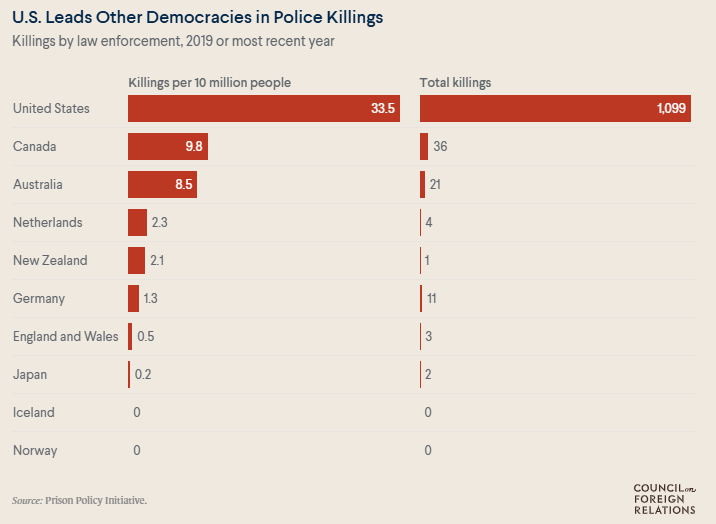
As you will, the rate at which people are killed by law enforcement is far higher in the USA. Whilst there are most certainly other factors at work here (not least of all the aforementioned gun culture), the quality of police training cannot fail to be a crucial element. Additional information can be found here.
Relevance to ICE
You may have wondered about the connection to ICE. Well, ICE (Immigration and Customs Enforcement) agents have training that lasts less than two months. ICE agents routinely defy police training about firing at moving vehicles, and the agent who killed Renee Good fell afoul not only of this, but of the rule about placing himself into a vehicle’s path. ICE agents are not given the skills needed to manage hostile situations, have assaulted bystanders, and there is little to no oversight of their actions, even in cases of death.
If standards of US policing are inconsistent and comparative weak against a lot of other developed nations, then it is of no surprise that ICE is even worse. Despite this, people will make excuses for their actions, and that is baffling.


Be First to Comment