Recently, London played host to a rally organised by far-right activist Tommy Robinson. As part of this rally (which included assaults on police officers), and in an act of tremendous irony, Elon Musk gave a speech via video link which the crowd lapped up, failing to understand precisely what made the whole affair so ironic (though this is a bit beside the point I am to make). What Robinson and his cadre want is to have Britain be for Britons, though you have to be of the right (or white) background. They don’t like foreigners and don’t want foreigner interference in British affairs. Well, this is what they say, but in reality they don’t mind. After all, why else would they gleefully lap up a speech from a foreign national, calling upon them to subvert democracy?

This is what Musk was effectively doing with his speech. The wealthiest man in the world, with an enormous presence on social media, has already been fanning the flames of violence against the left in the wake of Charlie Kirk’s murder, and in calling for an unnecessarily early election in the UK to vote out Labour, he is aiming to undermine the democratic process here. Somehow, in the eyes of Robinson and his thuggish allies, this is alright! Somehow the interference in UK affairs by foreigners becomes acceptable when it’s carried out by a billionaire South African with ties to the USA.

Make no mistake, we live in dangerous, uncertain times. Between the steady and determined influence of Putin’s Russia, the firebrand commentary of Trump, and Musk’s insidious effects to corrupt democracy for the purpose of wannabe Nazis (and make no mistake, that is precisely what Robinson and his hardline followers are), we face a world being stoked toward violence and insurrection. It is offensive to see powerful foreign nationals seek to damage the democratic process via inciting the mob, and it is absurd that the mob has elected to find this acceptable. As I said earlier, it is also ironic, but I suspect that irony will be lost on Robinson and his fans.

There’s further irony to be had. Whilst Musk and his cohorts claim the left seeks to censor the right, it’s Musk (whilst championing freedom of speech) who throttles progressive left-wing voices on Twitter. How can he be taken seriously as a bastion of freedom when he clamps down on those he doesn’t like, calls for insurrections, and aligns himself to wannabe Nazis?

There is further irony (I know, it keeps coming). The political right has, in recent days, been hurling accusations at the ‘violent’ left. It is interesting that the right has made little-to-no effort to strike a conciliatory tone, and figures like Trump and Musk have instead used aggressive language to denounce the left, without any self-awareness. It’s also interesting that the right (as referred in a prior post of mine) is more violent than the left. Is this of any surprise, given Musk’s recent comments? It’s certainly of no surprise to me.

Back to The Thinking ‘Kat

black rifle

It is by now a near-certainty that Derrick Thomas Thiessen will respond to my posts with his usual, vapid, misleading attacks, and his by-now normal, fearful excuses to evade accountability and transparency are being trotted out with each failure to conduct himself in a reasonable manner. His latest post failed to address the questions I posed of him, and instead he side-stepped the points I raised in favour of further dishonest rhetoric.

Derrick starts out by suggesting I employed a strawman argument. The strawman is where you attack an argument your opponent has not made, and it is something that Derrick himself employs on a routine basis. He made mention that blue states are among the most dangerous, yet I provided evidence for how red, conservative, Christian-majority states are in fact the most dangerous, refuting his claim. In Derrick’s eyes, this is somehow a strawman? I dare say this underscores Derrick’s lack of logical thinking.

In his latest post, he refers to cities. He claims that US cities with strict gun control are dangerous. Perhaps they are, but are they as dangerous as cities with weak gun control measures?

The short answer is no. Whether Derrick is prepared to acknowledge the actual numbers and evidence remains to be seen (he does seen to have an aversion to evidence), but let’s present it:

According to various sources (here, here, and here), one of the most violent cities in the US is Memphis, Tennessee. As established in my previous post, Tennessee is a red, conservative state with weak gun control measures. There are several locations in Louisiana (another red state with weak gun laws) that are among the most dangerous in the USA. In fact, according to the last link, three of the top ten most dangerous places in the USA are in Louisiana. It’s true that there are locations within blue states that are also dangerous places to be, but all that underscores is a point I have made several times (one I imagine Derrick will choose not to understand). Inconsistent gun laws which vary wildly from state to state have a negative impact on gun safety and gun crime.

It is pointless to address their responses, as it is casting pearls before swine. The point we were making, which was not addressed,d was the fact that gun control does not solve the problem, and it is a point that goes well above the head of MM (MM is Derrick’s cowardly evasive code for Ben Berwick of Meerkat Musings).

It is worth quoting Derrick Thomas Thiessen here, because this statement is yet another, spectacular lie. As pointed out on numerous occasions, and as backed up by various sources and examples, it is clear that gun control works. It exists in various forms around the world, and there is a reason that various developed countries of broadly similar political, economic and cultural similarity to the USA are a lot safer, especially in respect of gun violence. For Derrick to claim I have not addressed this is either pure dishonesty, or complete fantasy. In Derrick’s case it could be a bit of both!

Once again, I present to him some questions. They are of course optional (lest Derrick falsely whinge that I am demanding things of him), but let us see if he can muster up any conviction, and answer them. I would also wonder if he can finally prove he has enough confidence and faith in his arguments to offer correct, proper accreditation to me, or whether he will continue to cowardly hide behind his imaginary constructs?

  1. What makes Japan the safest country on earth?
  2. Why is the UK substantially safer than the USA?
  3. Why is Canada a lot safer than the USA?

Derrick Thomas Thiessen, the floor is yours.

Back to The Meerkat Responds

black rifle

… we received a response to our previous post from Derrick Thomas Thiessen, aka Mr David Tee of Theology Archaeology. As usual, Mr Thiessen was hugely selective in how he quoted my words, and he naturally lacked the faith in his stance to link to my post, which also signals dishonesty through omission.

Whilst Mr Thiessen may have an aversion to evidence, I do not. Among Derrick’s more lavish claims in his post was the notion that Democrat-run states and cities fare worse for gun crime:

If you watch the news, Chicago and Illinois, among other blue states and cities, have the strictest gun control laws, yet gun violence abounds within their borders. Gun control advocates need to wake up and see that their ideology does not work.

State vs State

To refer to some material I wrote a few years ago, which remains relevant:

Let’s start from the top. Urban areas, are they safer with or without guns? Among US cities, St. Louis has more murders per 100,000 people (64.54) than any other US city. Baltimore is next on 58.64 murders per 100,000 people. In third place is San Juan, with 54.01 murders per 100,000 people. Missouri, the State in which St. Louis resides, has some of the weakest gun control laws of any US State. Maryland (where Baltimore resides) is better, and Puerto Rico (host to San Juan) is quite slack. Detroit, fourth among US cities for murders, has a rate of 40.74 murders per 100,000 people, and Michigan, the State upon which Detroit sits in, has inconsistent gun laws. All figures are based on 2019.

It’s worth noting that Missouri is very-much a red state. In 2019, it hosted the most violent US city.

What about more recent data?

According to this article, in 2023 the five most dangerous US states were Mississippi, Louisiana, Alabama, New Mexico and Tennessee. Of the five most violent states, all but New Mexico have consistently voted Republican at Presidental Elections. None of these five states have particularly robust gun laws.

Will the safety of these states, and their problems with violence, be entirely down to guns? Of course not, but it would be insanely naieve to pretend the five most dangerous states in the USA, with some of the weakest gun laws in the country, are somehow better for lacking such weak gun control measures, and it’s most fascinating that four of these five states are Republican. This would seem to rubbish Derrick’s claims that we can blame Democrat states for the USA’s crime figures, and what’s more, in every state except New Mexico, more than 70% of adults identify as Christians. It seems these Christian conservative Republicans are quite dangerous. Hmm, perhaps Derrick is right, perhaps the problem is spiritual? Perhaps we should be asking how Christianity inspires violence?

Tongue-in-cheek moment aside, the evidence is clear. Republican states are the most dangerous, and it’s not a coincidence that their gun regulations are so slack.

A lot of this is beside the point. What Derrick, and other determined gun defenders fail to realise is that trying to pretend gun control doesn’t work, in favour of blaming spirituality, mental health etc, overlooks the considerable success of gun control measures elsewhere in the world. Britain, France, Germany, Japan… these countries all have issues pertaining to crime, and in some cases similar issues to the USA. Indeed, I made this point in my last post, and Derrick ignored it. I suspect he will ignore it again. What these countries have done is to employ methods designed to protect people, and they work. They’ve all taken different approaches, and the net sum of those approaches is visible in the table in my previous post, which Derrick ignored.

We can expand upon this. The Czech Republic is an irreligious country. By Derrick’s standards, he might deem it a nation of godless heathens. It’s also a country with a low murder rate, and gun control measures that are more robust than the USA’s, and more consistent. Derrick might think that the Czech Republic has a spiritual problem; what they do have is a safe country, one far safer than the USA.

The False Choice

They are too limited in their thinking and think that punishing everyone solves everything. As we know, gun control does not solve gun violence. Even in South Korea, where gun owners are required to have their guns locked up in the police station, gun murders still take place.

Here, Derrick employs a logical fallacy. He argues that for gun control to be considered effective, it must be 100% effective. By that reasoning, we should do away with seatbelts. They do not 100% prevent all injuries or deaths, so why bother? This is Derrick’s attitude, and it demonstrates a complete failure of logic and reason, though I look forward to his pretzel logic in an effort to explain himself.

The effectiveness of gun control need not be perfect for it to be valid, and despite Derrick’s constant whinging that I am referring to taking guns away, it is worth noting that effective gun control can be as simple as robust background checks. There are plenty of guns in circulation in Germany, and a sizable number of guns in the Czech Republic. They have not banned guns, and nor for that matter are they banned in the UK. There are strict rules around the types of firearms that are available, and a rigid process to ensure owners are responsible and competent, but if I wanted a gun here, I could have one.

So, Derrick’s false choices are two-fold. He dishonestly suggests that we must choose between 100% or zero. He misleads his readers with the idea that I advocate for gun bans. You do not need to ban guns to have gun control, and gun control does not need to be perfect for it to be considered effective. If a uniform, consistent approach to gun laws reduced gun crime by a third, would that not be worthwhile? Apparently in Derrick’s eyes this wouldn’t be worth it, though I await his clarification.

The Weapon vs the Tool

Yes, guns are designed as a weapon that can take a life, but guns are only deadly in the wrong hands. No matter how often sane minds remind gun control enthusiasts that guns are the tool, the latter continue to refuse to listen, as they want to force their way on those who disagree with them.

Guns are deadly, full-stop. It is ignorant to pretend otherwise, and Derrick’s whinge that pointing out the obvious is somehow forcing my way is as ignorant as it is ironic as it is stupid. They kill, it is what they are designed for, so pretending they only kill in the wrong hands is plain ridiculous. What does Derrick think guns are in the hands of police or the military? Shovels? Wrenches? No, they are weapons, not tools, and they kill.

This is such a tired argument, yet one that people cling to dogmatically. ‘Guns don’t kill people! Guns are merely tools!’ Well, they are the only ‘tool’ designed specifically to take life, and they are exceptionally efficient at this function. There is a reason guns are involved in the vast majority of mass killings. It is very hard to accomplish the same dire outcome with a hammer. People may kill people, but give them something built to kill, and they will find it a lot easier to kill more people. Put in place virtually no restrictions to purchasing these deadly weapons, and then bury your head in the sand as to what’s going on, and nothing will change. Pretend the problem is somehow spiritual, and nothing will change.

In the end, the facts speak for themselves. Derrick Thomas Thiessen may have a deep aversion to evidence and facts, but they won’t change to suit his whining. Guns are designed to kill, they are exceeding effective at this, and there is a reason that the nation with more guns than people also has the worst gun murder rate of any first-world country.

If Derrick is serious about a serious discussion around gun violence and gun control, then he has the option (and I must stress the word option, lest he spin this into his usual unreasonable claim that I am demanding things from him) to look at the following questions:

  1. What makes Japan the safest country on earth?
  2. Why is the UK substantially safer than the USA?
  3. Why is Canada a lot safer than the USA?

Let us see if he responds, and if he can respond using evidence.

Back to The Meerkat Responds

In the wake of the murder of political activist and Trump ally Charlie Kirk, there has been a lot of the usual rhetoric. ‘Guns are not the problem!’ ‘It’s evil lefties who carry out these sorts of crimes!’ ‘Now is not the time to talk about gun control!’ It’s the usual lines from the usual suspects, but are we looking at reasoned, rational statements, or are we in fact looking at inflammatory commentary, and the same hollow platitudes as before? Let’s break this down, but before I do, I want to make something clear.

I decidedly did not agree with Charlie Kirk on a host of issues. I found his arguments to be rooted in ignorance, and I found his debates with UK university students to be a fascinating study of how to frame defeats as victories. His willingness to cling to ignorance and declare success in his debates, when the evidence that showed him to be in error was everywhere… it was staggering. None of that, none of it, means he deserved to be shot down in cold blood. He had a wife and children, and more than that, I think no one should be gunned down for speaking. That sets a dangerous precedent, and raises the temperature of an already incendiary situation.

With that said, let’s begin.

‘It’s Evil Lefties!’

Violence in US politics cuts across the left/right divide. It was earlier in the year when a man disguised as a police officer killed two Democrats in their homes in Minnesota. A few years back Paul Pelosi, the husband of prominent Democrat Nancy Pelosi, was attacked in their home. It is thoroughly misleading to pretend that the political violence engulfing the USA flows in one direction, and a case of wilful ignorance if you believe right-wing commentary has never fanned the flames.

To underscore the violence from far-right extremists, I encourage people to look up this resource. It shows that it’s been the far-right that has been most violent in recent years.

‘Guns aren’t the Problem!’

Well, guns are by far the leading weapon of choice in US homicides. They have enabled the mass killing phenomenon in the USA, in a manner that far exceeds what we see of mass attacks in other parts of the world. I see conservative commentators insist the problem is with people, with mental health, spirituality, gangs etc… yet these commentators never pause to ask if these are issues that other parts of the world grapple with. Other developed first-world countries face these problems, yet have nowhere near the same problem with violent crime, especially gun crime. There’s no other first-world nation that has the same problem with mass shootings. There’s no other developed nation with as high a homicide rate as the USA, which is not uncoincidentally the nation with the weakest and most inconsistent gun control.

To illustrate just how much guns influence the USA for the worse, I invite you to check out this link, and this link, providing details of overall homicide rates, and homicide rates with guns alone. Below, I’ve created a table to highlight the relevant information:

CountryMurder Rate (per 100,000 people)Murder rate with Firearms
USA (2023)5.84.4
Canada (2023)20.7
UK (2021)1.1<0.1
Australia (2023)0.9<0.1
New Zealand (2022)1.50.2
France (2024)1.3<0.1
Spain (2023)0.7<0.1
Germany (2023)0.9<0.1
Czech Republic (2023)0.80.3
South Korea (2023)0.50
Japan (2023)0.2<0.1

Now, I will grant some discrepancies here. The data is not all from one year, and the data on gun homicides is across an even greater range of years (France’s gun homicide data comes from 2017). Nonetheless, the facts speak for themselves. Only one country on that list has a love affair with guns, and a series of varying laws across states, and even within states. That country has a far higher murder rate, even with guns alone, than several of the other countries combined.

It isn’t just about gun control, but also gun culture. Broadly speaking, Americans have turned the gun into a cultural symbol, one that many seem to revere, even worship. To take a deadly weapon (and let’s not pretend guns are anything but deadly weapons, they are designed to take life after all) and fawn over it, instead of respecting what it can do, is a dangerous game.

‘Now is not the time to talk about gun control!’

If now is not the time, then when? If there were, say, a cooling off period of even a week before anyone could be permitted to speak of gun control, it would never get discussed, because there would be another tragic shooting in that time frame. The bottom line is that gun control is something that should always be discussed, until something happens that turns the tide of gun violence. Unfortunately the gun lobbies in the USA are rich, powerful organisations, with their claws firmly embedded in politicians. With so much power and money invested by these organisations, things are unlikely to change. That doesn’t mean people should fall silent, least of all in times of tragedy. It’s in such times that people should speak out.

Those are my thoughts. I can only imagine how they will be perceived, but I cannot control that. I can only say what I have to say.

Back to The Thinking ‘Kat

Lately, there has been an explosion of people putting up the St George’s Cross, or the Union Jack, across various locations around the country. The belief seems to be that by putting up the flags the country can somehow be reclaimed, though from what is unclear. It’s also not clear how flags are supposed to do this.

Apparently, to have a flag, or paint it upon a roundabout (leaving aside the hilariously unfortunate case of people painting the Danish flag by mistake) is a display of patriotic pride, a call to arms, an opportunity to beat one’s chest in a display of nationalistic fervour. As already expressed, why is this going on? Who feels the need to offer up these demonstrations of pride?

It seems there is a certain section of UK society that wants to recapture Britishness (whatever that is). They want Britain to be for Brits, whoever they are. Of course, we all know the subtext, even if the subtext allegedly gives way to an ugly word. The ones who are singing loudest about these performative gestures are virtually invariably white men, and they do not display patriotic love – they are more interested in racial pride. There, I said it. I spoke the undesirable truth behind many of these flag-waving performances.

The unfortunate fact is that the St George’s Cross in particular has been an historic symbol for the far right. They wielded it in the late 1970s, and stained it with what is in fact a distinctly un-British attitude. Since then, the flag has made a recovery, often used as a symbol during football tournaments, but that unsavoury connection to far right extremism has remained, and this has not be aided by the anti-migrant marches recently seen in this country.

Does Britain have a migrant problem? That depends. Have there been some high-profile cases of migrants attacking and hurting people? Yes. These are horrible instances, and those who perpetrated those crimes should be punished. Where the flag-wavers fall silent is when their own rank and file commit similar, terrible deeds. Far right groups use misogyny as a recruit tool. These same groups only protest violence toward women when it comes from ethnic minorities, suggesting their motive is not about the safety of women, but rather about demonising and ‘othering’ anyone who is not white. The media speaks to us of grooming gangs, yet there are groups of white men who are just as awful as any ethnic minority gang, and you don’t see the flag-wavers protesting their influence.

As to the broader, more generic complaints about immigration, I would suggest people look to how many immigrants have successfully integrated into our society, becoming doctors, dentists, delivery drivers, and a whole lot more. They willingly and happily contribute to this country, yet face being ostracised by ignorant fools who believe waving the flag makes them more patriotic than those who work for their communities. I would much rather have immigrants for neighbours than far right flag wavers, especially given the aggressive posturing of the latter.

In the end, this entire affair is one huge smokescreen. Remember that famous cartoon, where a rich banker takes nine out of ten cookies, then tells the worker that the immigrant is after their cookie? That’s us. That’s UK society, right now. The biggest problems in this nation have nothing to do with immigration. They never did.

Back to The Thinking’ Kat

Today, the government announced the voting age will be lowered for the next General Election, with 16 and 17 year-olds being able to cast their ballots. This follows through with a pledge made during the last election campaign. Whilst Keir Starmer’s government is letting down the very people they are supposed to represent in so many ways, this is a good pledge to honour, though I can imagine there will be resistance to it.

Currently, the trend for older generations is to vote for conservative, right-wing parties. See the below chart:

Statistic: Voting intentions in a general election in the United Kingdom as of July 2025, by age group | Statista
Find more statistics at Statista

Younger people have a preference for left-wing (or ostensibly left-wing, like Labour) parties. It would thus seem that opening the floor up to 16 and 17 year-olds will see a greater pool of voters favouring Labour and the Lib Dems. More importantly, it gives young people more of a voice over their futures. The present trend is for those who are older to vote for policies and parties that won’t have much of an impact on them, but will affect the lives of younger generations. Brexit is a prime example of this, with a lot of people from older generations voting for it, despite not having to face the long-term consequences of it.

I can hear the squeals from the right already. ‘They’re kids, they’re too young to understand what they want and what they vote for!’ Well, they’re old enough to go to work, old enough to get married in some circumstances, and old enough (at 17) to be trusted to drive. They’re old enough to start paying taxes and National Insurance. They’re impacted by political and economic decisions. Does this not give them the right to a voice?

Some people argue there is a disconnect between not permitting 16 year-olds to stand as MPs (you must be 18 for that), but I see no issue here. There is a broad difference between voting, and taking on responsibility for running a constituency. What I see is an effort to give a voice to people whose futures are more at risk by government decisions.

Could it backfire? Of course! We might see a rise in efforts from right-wing populists like Farage to court young, impressionable minds. However, as per the chart above, it seems like as a rule, Britain’s youth have a preference for compassion and equality.

Back to The Thinking ‘Kat

Full confession, I have no idea who Matt Goodwin is. Whoever he is, he is running around Twitter, upset that people with serious, life-altering disabilities might earn more than someone who is working. What doesn’t appear to matter to Mr Goodwin is the costs those on PIPs often incur. They can face nearly £1,000 worth of additional expenses, according to the charity Scope.

I am fortunate. I am not disabled. I do know people who are. They are not living in luxury, far from it. They would rather not be disabled and able to work, but life has dealt them poor cards, and now they must make the best of it. Instead of advocating for treating them as a burden, how about we treat them as human beings, eh Matt? Or is empathy too hard?

Mr Goodwin’s complaint could be resolved by, oh, I don’t know, paying higher wages? I’m sure we’ll hear the usual misleading squeals about inflation, and all the usual crap that those in power wield to prevent something as straight-forward as that, but that is where the crux of the matter rests. Mr Goodwin is that part of that element of society that clearly values wealth ahead of doing what’s right, so small wonder then that he would prefer to cut benefits from those who rely upon them, than campaign for greater equity of outcomes.

Back to The Thinking ‘Kat

One of my favourite people to follow on Twitter is The Bear. It is abundantly clear that this bear has claws, and many a hard-right conservative who has attempted to cross him has discovered his claws are razor-sharp.

The Bear also runs a website, Bearly Politics, through which he expands his thoughts and witty takedowns of conservative folly. He has kindly granted me permission to quote from his latest post, which concerns an exchange with one Peter McCormack. It seems Mr McCormack is a shrill for the rich, sycophantically believing we should be fawning at their feet, and showing gratitude for the opportunities they convey upon the commoners.

Surely Mr McCormack is not serious?

How much appreciation are we supposed to show? How much ass-kissing are we meant to do? Yes, the wealthy technically pay more tax, but they also horde more wealth! In a prior post of mine, I took a good look at what the richest Americans have, and what could be accomplished with a mere fraction of that. Instead, The Bear makes an astute observation:

Thank them.

For existing, presumably. For blessing us with their divine capital. For graciously allowing us to bask in the warm glow of their wealth while they build rocket ships for joyrides, offshore their profits through seventeen shell companies, spend £40m on a wedding and call writing a cheque to their mate’s foundation “philanthropy.”

How very generous of them. How utterly selfless.

Anyway.

Whilst the rich spaff money up the wall on hideously expensive vanity projects, splash out on yet another massive yacht, and host lavish weddings, the rest of us are not so fortunate, despite whatever ill-conceived notions Mr McCormack may hold about our lords and betters benefactors.

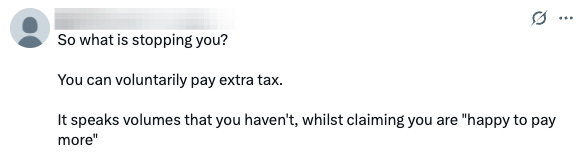
When The Bear mentions he is quite happy to actually pay more tax, considering his own relative wealth, someone decided to apply what they thought was a clever ‘gotcha’ moment:

In my response, I pointed out the incredibly privileged position I have that I am, in fact, in the top 10% (that’s anyone earning above £60k a year in the UK for the record – not quite yachts and private jets), and that I please do not wish to receive thank you notes or applause (because that’s weird). I added that I would be fine – content, even – to pay a bit more tax. Especially if we finally got around to making National Insurance progressive.

And that, my friends, triggered them. Badly.

You know the “them” who I’m talking about.

We’ve all seen this same argument a million times.

Of course, this wasn’t the ‘gotcha’ that they had hoped…

The people who think tax is theft, billionaires are just misunderstood visionaries, and anyone who supports public goods should be personally topping up the Treasury like it’s a GoFundMe. The ones who shout “you can just donate more!” like it’s the ultimate gotcha, while presumably afterwards sniggering at themselves for how well they’ve owned someone. The ones who still think the tax system works like an itemised bill and forget that the NHS isn’t just a line on a spreadsheet – it’s a living, breathing social contract.

And I think it’s worth exploring this reaction, because we need to prod at the actual logic behind the “just send a cheque” wails – and why it spectacularly misses the point.

To apply my own thought process here, the idea of ‘pay for it yourself’ is the sort of logic that leads us toward a US-style healthcare system, which as anyone with eyes and ears can tell you, is a disastrous one. Whilst the NHS is far from perfect, the number of people who are bankrupted by medical bills is precisely zero. This is because here in the UK, and in most of the rest of the world, there is an understanding that everyone – rich and poor alike – benefits from a nationalised healthcare service. Instead of a strange sort of social Darwinism (and isn’t that ironic, considering how many conservatives are also devout Christians!), the NHS is a fair system to all, as opposed to a privilege where your money determines your social worth.

Some people view tax as theft, and see the robbers – the government – as being the absolute last people we should trust with public money. It’s certainly true that governments can be incompetent and corrupt, but then again, should we trust the philanthropy and mercy of the rich? See my earlier linked post; it would cost $20 billion to end homelessness in the USA, easily within reach if even one of the top 100 richest Americans chose to do so, yet nothing happens. Apparently, ending a serious social problem is unfair, and letting Elon Musk waste money with exploding rockets is absolutely fair. Privatisation has proven to be a massive failure too.

To return to Britain’s shores, it is already those who are less affluent who bear the greatest burden. The millionaires and billionaires can absorb higher tax rates, and remain millionaires and billionaires. Cutting the benefits of those who are already living paycheque-to-paycheque is an act of cruelty. It’s absurd. It does not provide public services with the sort of funding they actually need.

To apply the homelessness example to the UK, Crisis estimates it would cost £1.9 billion to end this problem. If you take a look at The Sunday Times Rich List 2025, any of the top 10 could afford this, and remain billionaires by a comfortable margin. It seems people like Mr McCormack would prefer instead to blow smoke up the backsides of the billionaires, and fawn over them, instead of holding them to account and reminding them they live in a society that also pays their wages.

Back to The Thinking ‘Kat

Of late, I have been having a lengthy exchange with Tom, of Citizen Tom, on matters pertaining to taxes, the morality of taxes, the role of government. Tom has some peculiar beliefs about what is and is not a justifiable, and even moral use of taxpayer money. He also appears quite wedded to a system of greed, which I will come to in a moment.

His post regarding our mutual comments elsewhere doesn’t really address the thrust of our conversation, with preferences for misdirection about the poor, embattled Trump, and the allegedly socialist Democrats. Note that he also does not address the contents of one of my prior posts, preferring to offer philosophical remarks that offer nothing of actual substance. He also betrays his own abuse of numbers.

What is the Role of Government?

Tom is American, and a deeply conservative one at that. He sees everything through the lens of the Declaration of Independence and the Constitution. There appears to be little room for deviation from this. He believes the role of government should be minimal, and subscribes to the notion that it should only really be involved in what he regards as the security of the country. He does not believe there should much government involvement in education, healthcare, or social care. He objects to the use of taxpayer money contributing in these areas. He has no objection to his tax dollars paying for military services, or border control.

Section 8 of the Constitution declares: The Congress shall have Power To lay and collect Taxes, Duties, Imposts and Excises, to pay the Debts and provide for the common Defence and general Welfare of the United States; but all Duties, Imposts and Excises shall be uniform throughout the United States.

Emphasis mine. See that? General Welfare. Welfare is defined by the dictionary in two ways. Firstly, ‘the health, happiness, and fortunes of a person or group’. Secondly, a ‘statutory procedure or social effort designed to promote the basic physical and material well-being of people in need’.

What might be considered a basic material need? One World Beyond Borders defines the four basic needs as food, shelter, clothing and healthcare.

What about those four needs strikes anyone as unreasonable? I am curious to know if anyone feels that providing of those needs is somehow morally dubious, or a poor use of tax dollars?

It certainly seems that Tom believes these are morally dubious activities for a government to be involved in. It is easier for him to decry anything that he feels remotely suggests the lurking bogeyman of socialism, than to develop ideas and solutions to help the 11% of Americans living below the poverty line. It is more morally right for the much-hyped, often over-stated matter of immigration to receive taxpayer dollars. ICE will shortly be in receipt of $45 billion, and total funding for immigration enforcement will reach $150 billion. The cost of erasing homelessness? $20 billion, less than half what ICE will receive. In fact (and this is rather ironic, in light of DOGE), ICE will soon grow beyond several other federal departments combined. To quote directly from the link:

According to AIC Senior Fellow Aaron Reichlin-Melnick, each year, ICE will now be flushed with more cash than the Federal Bureau of Investigations; Drug Enforcement Administration; Bureau of Alcohol, Tobacco, Firearms and Explosives; U.S. Marshals Service; and Bureau of Prisons combined. In fact, with the bill’s passage, Reichlin-Melnick told Democracy Now!, ICE will become the largest federal law enforcement agency “in the history of the nation.”

This seems to be morally acceptable to Tom, and he has no problem with vast sums of taxpayer money funding this. I wonder if he considers morally acceptable that much of the funds for this, and the funds affording tax breaks for corporations and the affluent, are coming from social and medical care for those who are already impoverished?

After all, the role of the government is to ensure the welfare of its people, and the only thing that affects the welfare of the American people is illegal immigrants right… right?!

The Morality of Spending Other People’s Money

Tom’s objection to helping people fountains out from the belief that governments are inherently bad, and cannot be entrusted with anything other than the most limited of responsibilities. A lot of this is down to theological beliefs; Tom misguidedly believes the USA to be a Christian nation, a belief that stands at odds with why so many fled to the Americas in the first place, as well as ignorance of the USA’s founding principles. As I explained to him, the USA was founded by immigrants, and built by immigrants. Over the years, millions of people from all over the world have found homes in the USA. The US has always been a melting pot of cultures and beliefs, with all being welcome. Tom is happy to see tax dollars pay for anti-immigration measures, to preserve ‘cultural identity’, but he forgets that the USA has never been as homogenous as he thinks it is.

Tom also objects to secular schooling. For this reason, he does not want taxes funding education. His belief that public healthcare is wrong is based on the idea that people should fend for themselves. He does not want people to suckle on the government teat, as it were. Of course, previously he has had no answer to wage inequality, and a general culture that values the hording of wealth. Does Tom advocate for businesses to pay a living wage? Of course not, because that is unfair to the corporations and their profit margins! It is most unkind to suggest that the billionaires pay their employees better, why offer better wages, why chip into the huge profits, when all people need to do is work even harder to magically improve their circumstances?

Tom would entrust education, healthcare, and who-knows-what-else to private interests. He believes that with appropriate government oversight, private businesses can better serve the public. What he does not understand is that private businesses are more concerned with the bottom line. They operate to satisfy shareholders. They can and do cut corners to achieve higher profit margins. They will not pay better wages without being cajoled into doing so. In Britain, we suffer the cost of privatised water and energy, and we are expected to shoulder the burden of bailing out failing companies, and creaking infrastructure.

So, private control over key public services tends to raise the costs to the public, whilst delivering no noticeable improvements! In fact, services have often gotten worse here in the UK. With this in mind, it is morally reasonable to place vital services into private hands, or is it in fact better to place these services under public control, to actually serve the public interest?

Obviously this is not a perfect solution. Governments can be lousy. They be corrupt. They can influenced by wealthy backers (just look at Trump and his relationships with Musk and Bezos). However, there are also plenty of demonstrations that they can handle certain sectors a lot better, and that it is morally, financially and socially better to have the likes of education, healthcare etc in public hands. You need only look at the Nordic countries. Denmark consistently ranks as the happiest country on earth. Yes, they pay more in taxes, but they also have less than one percent of their population living under the poverty line. No one goes bankrupt from medical bills. The quality of their healthcare system is superior to the USA’s. The Danish education system is consistently ranked as one of the best in the world.

It seems the ‘objection’ to publicly funding key services comes not from a meaningful place, but rather, simply down to ideology. That, and fear of the government bogeyman. Instead, Tom appears to be wedded to the idea of greed being best. He does not have a problem with people hording wealth whilst others struggle to put food on the table, and that is a shocking attitude for a supposedly pious follower of Christ.

Update 11/7/25:

As is his want, the cowardly Derrick Thiessen recently provided some ‘commentary‘ on my posts about the role of government. Leaving aside his awful views on genital mutilation (which Bruce Gerencser has already dismantled), what does this fool have to say about my posts?

Well, ultimately the answer is nothing. Derrick Thiessen has nothing to say. He does not address the content of my posts, he does not link to them, and as ever, he lacks the strength of his convictions to even use my name. Cowards will do what cowards will do, and in this instance, yet again, Derrick Thiessen lies through omission. To offer one quote from his post:

#2. The Role of Government

The title of this section comes from MM’s website (my initials aren’t even MM, so the idiot can’t even get that right!) and we are not interested in his convoluted and wrong logic about government. What people are confused about is the actual role the government plays in life. Most suggestions are made from personal subjective interpretation and opinion, not facts.

His entire opening statement is wrong. He obviously did not read my posts. There is nothing subjective about the fact that it would cost $20 billion to erase homelessness in the USA, and that the money is clearly there. There is nothing subjective about the success of the Nordic nations where it comes to healthcare and education performance, and these countries score highly with regards to poverty indexes too. These are facts, and arguments borne from those facts are far more logical than Thiessen’s ‘obey God or be bad’ reasoning. Notice that he does not dare tackle specifics of my arguments. This is because he can’t. He lacks the critical reasoning skills to do so.

Back to The Thinking ‘Kat

Welcome to the in what I think is best suited to a five-rounds each debate, on the topic of whether or not public healthcare services (think of the NHS in the UK) are better than the US-style private healthcare service. It’s a simple enough premise, which system is best? I will be advocating for public healthcare, I suspect Silence will prefer to argue in favour of private healthcare.

As to the structure, my proposal is five posts each. I don’t particularly want to impose a word-count, however if Silence wishes to suggest ideas over post length, that is fine. Since Silence is the challenged party, he may also have the choice of whether or not to go first.

Where possible, links should be provided to sources. Reasoning should be explained. I don’t feel a particular need for any additional conditions, but we shall see if Silence has any he may wish to add.

Back to Meerkat Debates