Lately, there has been an explosion of people putting up the St George’s Cross, or the Union Jack, across various locations around the country. The belief seems to be that by putting up the flags the country can somehow be reclaimed, though from what is unclear. It’s also not clear how flags are supposed to do this.

Apparently, to have a flag, or paint it upon a roundabout (leaving aside the hilariously unfortunate case of people painting the Danish flag by mistake) is a display of patriotic pride, a call to arms, an opportunity to beat one’s chest in a display of nationalistic fervour. As already expressed, why is this going on? Who feels the need to offer up these demonstrations of pride?

It seems there is a certain section of UK society that wants to recapture Britishness (whatever that is). They want Britain to be for Brits, whoever they are. Of course, we all know the subtext, even if the subtext allegedly gives way to an ugly word. The ones who are singing loudest about these performative gestures are virtually invariably white men, and they do not display patriotic love – they are more interested in racial pride. There, I said it. I spoke the undesirable truth behind many of these flag-waving performances.

The unfortunate fact is that the St George’s Cross in particular has been an historic symbol for the far right. They wielded it in the late 1970s, and stained it with what is in fact a distinctly un-British attitude. Since then, the flag has made a recovery, often used as a symbol during football tournaments, but that unsavoury connection to far right extremism has remained, and this has not be aided by the anti-migrant marches recently seen in this country.

Does Britain have a migrant problem? That depends. Have there been some high-profile cases of migrants attacking and hurting people? Yes. These are horrible instances, and those who perpetrated those crimes should be punished. Where the flag-wavers fall silent is when their own rank and file commit similar, terrible deeds. Far right groups use misogyny as a recruit tool. These same groups only protest violence toward women when it comes from ethnic minorities, suggesting their motive is not about the safety of women, but rather about demonising and ‘othering’ anyone who is not white. The media speaks to us of grooming gangs, yet there are groups of white men who are just as awful as any ethnic minority gang, and you don’t see the flag-wavers protesting their influence.

As to the broader, more generic complaints about immigration, I would suggest people look to how many immigrants have successfully integrated into our society, becoming doctors, dentists, delivery drivers, and a whole lot more. They willingly and happily contribute to this country, yet face being ostracised by ignorant fools who believe waving the flag makes them more patriotic than those who work for their communities. I would much rather have immigrants for neighbours than far right flag wavers, especially given the aggressive posturing of the latter.

In the end, this entire affair is one huge smokescreen. Remember that famous cartoon, where a rich banker takes nine out of ten cookies, then tells the worker that the immigrant is after their cookie? That’s us. That’s UK society, right now. The biggest problems in this nation have nothing to do with immigration. They never did.

Back to The Thinking’ Kat

When you think of tea, I would wager most people are going to think of the drink. Well, there’s now a new form of tea, in the shape of an app, and it’s an app that has left men in a state of uproar.

Why, you might ask? Well you see, Tea is designed for women. It’s purpose is for women to report experiences to other women about men. Well, OK, it’s not really for that purpose, it’s to verify the identity of people on match-making sites, though women can certainly use it to check the men they’re interested in are who they say they are. Women can share experiences and provide warnings, and do so within a space that is exclusively theirs. Men cannot sign up to the app.

Predictably, this has provoked complaints and discussion. There are men who are worried about their reputations being unfairly maligned. Others fear their antics being brought into the light, and have called out the app for the possibility of doxxing. Of course the possibility exists, but this will pale in comparison to the help it provides women with. Men who have not abused, threatened, scammed and cheated will have no reason to fear this app. Men who have behaved in a poor manner will, and it will be of no surprise if it turns out those men are the ones most concerned.

The idea of spaces for women to share their thoughts, impressions and experience always seems to rile up men of a particular ilk. It matters not that men have their spaces, it seems awful to these men that women should be permitted a place to speak freely, without fear of reprisals. I for one applaud this app, where the positives will far outweigh the negatives.

Edit, 30/7/25:

The cowardly, woman-hating idiot Derrick Thiessen has yet again weighed in on one of my posts, in his usual cowardly manner. He doesn’t like the Tea App because it grants women a measure of control, a means of safe communication. He would prefer women to known their place, which is hardly surprising; he was once quizzed by police over abuse claims, and all he ever does is whinge that women lie (particularly ironic, given his preference for dishonesty).

Edit, 31/7/25:

The cowardly woman-hater Derrick Thiessen has continued to whinge, responding with further ignorant, cherry-picking ‘information’, whilst demanding women use the app in what he deems to be the correct manner. Considering his past treatment of women, and his dishonesty, women would probably be better off ignoring him.

Back to The Thinking’ Kat

Today, the government announced the voting age will be lowered for the next General Election, with 16 and 17 year-olds being able to cast their ballots. This follows through with a pledge made during the last election campaign. Whilst Keir Starmer’s government is letting down the very people they are supposed to represent in so many ways, this is a good pledge to honour, though I can imagine there will be resistance to it.

Currently, the trend for older generations is to vote for conservative, right-wing parties. See the below chart:

Statistic: Voting intentions in a general election in the United Kingdom as of July 2025, by age group | Statista
Find more statistics at Statista

Younger people have a preference for left-wing (or ostensibly left-wing, like Labour) parties. It would thus seem that opening the floor up to 16 and 17 year-olds will see a greater pool of voters favouring Labour and the Lib Dems. More importantly, it gives young people more of a voice over their futures. The present trend is for those who are older to vote for policies and parties that won’t have much of an impact on them, but will affect the lives of younger generations. Brexit is a prime example of this, with a lot of people from older generations voting for it, despite not having to face the long-term consequences of it.

I can hear the squeals from the right already. ‘They’re kids, they’re too young to understand what they want and what they vote for!’ Well, they’re old enough to go to work, old enough to get married in some circumstances, and old enough (at 17) to be trusted to drive. They’re old enough to start paying taxes and National Insurance. They’re impacted by political and economic decisions. Does this not give them the right to a voice?

Some people argue there is a disconnect between not permitting 16 year-olds to stand as MPs (you must be 18 for that), but I see no issue here. There is a broad difference between voting, and taking on responsibility for running a constituency. What I see is an effort to give a voice to people whose futures are more at risk by government decisions.

Could it backfire? Of course! We might see a rise in efforts from right-wing populists like Farage to court young, impressionable minds. However, as per the chart above, it seems like as a rule, Britain’s youth have a preference for compassion and equality.

Back to The Thinking ‘Kat

Full confession, I have no idea who Matt Goodwin is. Whoever he is, he is running around Twitter, upset that people with serious, life-altering disabilities might earn more than someone who is working. What doesn’t appear to matter to Mr Goodwin is the costs those on PIPs often incur. They can face nearly £1,000 worth of additional expenses, according to the charity Scope.

I am fortunate. I am not disabled. I do know people who are. They are not living in luxury, far from it. They would rather not be disabled and able to work, but life has dealt them poor cards, and now they must make the best of it. Instead of advocating for treating them as a burden, how about we treat them as human beings, eh Matt? Or is empathy too hard?

Mr Goodwin’s complaint could be resolved by, oh, I don’t know, paying higher wages? I’m sure we’ll hear the usual misleading squeals about inflation, and all the usual crap that those in power wield to prevent something as straight-forward as that, but that is where the crux of the matter rests. Mr Goodwin is that part of that element of society that clearly values wealth ahead of doing what’s right, so small wonder then that he would prefer to cut benefits from those who rely upon them, than campaign for greater equity of outcomes.

Back to The Thinking ‘Kat

One of my favourite people to follow on Twitter is The Bear. It is abundantly clear that this bear has claws, and many a hard-right conservative who has attempted to cross him has discovered his claws are razor-sharp.

The Bear also runs a website, Bearly Politics, through which he expands his thoughts and witty takedowns of conservative folly. He has kindly granted me permission to quote from his latest post, which concerns an exchange with one Peter McCormack. It seems Mr McCormack is a shrill for the rich, sycophantically believing we should be fawning at their feet, and showing gratitude for the opportunities they convey upon the commoners.

Surely Mr McCormack is not serious?

How much appreciation are we supposed to show? How much ass-kissing are we meant to do? Yes, the wealthy technically pay more tax, but they also horde more wealth! In a prior post of mine, I took a good look at what the richest Americans have, and what could be accomplished with a mere fraction of that. Instead, The Bear makes an astute observation:

Thank them.

For existing, presumably. For blessing us with their divine capital. For graciously allowing us to bask in the warm glow of their wealth while they build rocket ships for joyrides, offshore their profits through seventeen shell companies, spend £40m on a wedding and call writing a cheque to their mate’s foundation “philanthropy.”

How very generous of them. How utterly selfless.

Anyway.

Whilst the rich spaff money up the wall on hideously expensive vanity projects, splash out on yet another massive yacht, and host lavish weddings, the rest of us are not so fortunate, despite whatever ill-conceived notions Mr McCormack may hold about our lords and betters benefactors.

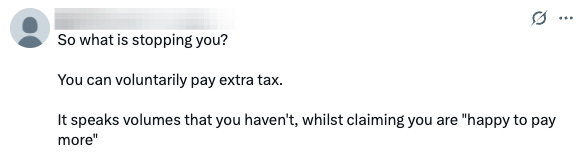
When The Bear mentions he is quite happy to actually pay more tax, considering his own relative wealth, someone decided to apply what they thought was a clever ‘gotcha’ moment:

In my response, I pointed out the incredibly privileged position I have that I am, in fact, in the top 10% (that’s anyone earning above £60k a year in the UK for the record – not quite yachts and private jets), and that I please do not wish to receive thank you notes or applause (because that’s weird). I added that I would be fine – content, even – to pay a bit more tax. Especially if we finally got around to making National Insurance progressive.

And that, my friends, triggered them. Badly.

You know the “them” who I’m talking about.

We’ve all seen this same argument a million times.

Of course, this wasn’t the ‘gotcha’ that they had hoped…

The people who think tax is theft, billionaires are just misunderstood visionaries, and anyone who supports public goods should be personally topping up the Treasury like it’s a GoFundMe. The ones who shout “you can just donate more!” like it’s the ultimate gotcha, while presumably afterwards sniggering at themselves for how well they’ve owned someone. The ones who still think the tax system works like an itemised bill and forget that the NHS isn’t just a line on a spreadsheet – it’s a living, breathing social contract.

And I think it’s worth exploring this reaction, because we need to prod at the actual logic behind the “just send a cheque” wails – and why it spectacularly misses the point.

To apply my own thought process here, the idea of ‘pay for it yourself’ is the sort of logic that leads us toward a US-style healthcare system, which as anyone with eyes and ears can tell you, is a disastrous one. Whilst the NHS is far from perfect, the number of people who are bankrupted by medical bills is precisely zero. This is because here in the UK, and in most of the rest of the world, there is an understanding that everyone – rich and poor alike – benefits from a nationalised healthcare service. Instead of a strange sort of social Darwinism (and isn’t that ironic, considering how many conservatives are also devout Christians!), the NHS is a fair system to all, as opposed to a privilege where your money determines your social worth.

Some people view tax as theft, and see the robbers – the government – as being the absolute last people we should trust with public money. It’s certainly true that governments can be incompetent and corrupt, but then again, should we trust the philanthropy and mercy of the rich? See my earlier linked post; it would cost $20 billion to end homelessness in the USA, easily within reach if even one of the top 100 richest Americans chose to do so, yet nothing happens. Apparently, ending a serious social problem is unfair, and letting Elon Musk waste money with exploding rockets is absolutely fair. Privatisation has proven to be a massive failure too.

To return to Britain’s shores, it is already those who are less affluent who bear the greatest burden. The millionaires and billionaires can absorb higher tax rates, and remain millionaires and billionaires. Cutting the benefits of those who are already living paycheque-to-paycheque is an act of cruelty. It’s absurd. It does not provide public services with the sort of funding they actually need.

To apply the homelessness example to the UK, Crisis estimates it would cost £1.9 billion to end this problem. If you take a look at The Sunday Times Rich List 2025, any of the top 10 could afford this, and remain billionaires by a comfortable margin. It seems people like Mr McCormack would prefer instead to blow smoke up the backsides of the billionaires, and fawn over them, instead of holding them to account and reminding them they live in a society that also pays their wages.

Back to The Thinking ‘Kat

Of late, I have been having a lengthy exchange with Tom, of Citizen Tom, on matters pertaining to taxes, the morality of taxes, the role of government. Tom has some peculiar beliefs about what is and is not a justifiable, and even moral use of taxpayer money. He also appears quite wedded to a system of greed, which I will come to in a moment.

His post regarding our mutual comments elsewhere doesn’t really address the thrust of our conversation, with preferences for misdirection about the poor, embattled Trump, and the allegedly socialist Democrats. Note that he also does not address the contents of one of my prior posts, preferring to offer philosophical remarks that offer nothing of actual substance. He also betrays his own abuse of numbers.

What is the Role of Government?

Tom is American, and a deeply conservative one at that. He sees everything through the lens of the Declaration of Independence and the Constitution. There appears to be little room for deviation from this. He believes the role of government should be minimal, and subscribes to the notion that it should only really be involved in what he regards as the security of the country. He does not believe there should much government involvement in education, healthcare, or social care. He objects to the use of taxpayer money contributing in these areas. He has no objection to his tax dollars paying for military services, or border control.

Section 8 of the Constitution declares: The Congress shall have Power To lay and collect Taxes, Duties, Imposts and Excises, to pay the Debts and provide for the common Defence and general Welfare of the United States; but all Duties, Imposts and Excises shall be uniform throughout the United States.

Emphasis mine. See that? General Welfare. Welfare is defined by the dictionary in two ways. Firstly, ‘the health, happiness, and fortunes of a person or group’. Secondly, a ‘statutory procedure or social effort designed to promote the basic physical and material well-being of people in need’.

What might be considered a basic material need? One World Beyond Borders defines the four basic needs as food, shelter, clothing and healthcare.

What about those four needs strikes anyone as unreasonable? I am curious to know if anyone feels that providing of those needs is somehow morally dubious, or a poor use of tax dollars?

It certainly seems that Tom believes these are morally dubious activities for a government to be involved in. It is easier for him to decry anything that he feels remotely suggests the lurking bogeyman of socialism, than to develop ideas and solutions to help the 11% of Americans living below the poverty line. It is more morally right for the much-hyped, often over-stated matter of immigration to receive taxpayer dollars. ICE will shortly be in receipt of $45 billion, and total funding for immigration enforcement will reach $150 billion. The cost of erasing homelessness? $20 billion, less than half what ICE will receive. In fact (and this is rather ironic, in light of DOGE), ICE will soon grow beyond several other federal departments combined. To quote directly from the link:

According to AIC Senior Fellow Aaron Reichlin-Melnick, each year, ICE will now be flushed with more cash than the Federal Bureau of Investigations; Drug Enforcement Administration; Bureau of Alcohol, Tobacco, Firearms and Explosives; U.S. Marshals Service; and Bureau of Prisons combined. In fact, with the bill’s passage, Reichlin-Melnick told Democracy Now!, ICE will become the largest federal law enforcement agency “in the history of the nation.”

This seems to be morally acceptable to Tom, and he has no problem with vast sums of taxpayer money funding this. I wonder if he considers morally acceptable that much of the funds for this, and the funds affording tax breaks for corporations and the affluent, are coming from social and medical care for those who are already impoverished?

After all, the role of the government is to ensure the welfare of its people, and the only thing that affects the welfare of the American people is illegal immigrants right… right?!

The Morality of Spending Other People’s Money

Tom’s objection to helping people fountains out from the belief that governments are inherently bad, and cannot be entrusted with anything other than the most limited of responsibilities. A lot of this is down to theological beliefs; Tom misguidedly believes the USA to be a Christian nation, a belief that stands at odds with why so many fled to the Americas in the first place, as well as ignorance of the USA’s founding principles. As I explained to him, the USA was founded by immigrants, and built by immigrants. Over the years, millions of people from all over the world have found homes in the USA. The US has always been a melting pot of cultures and beliefs, with all being welcome. Tom is happy to see tax dollars pay for anti-immigration measures, to preserve ‘cultural identity’, but he forgets that the USA has never been as homogenous as he thinks it is.

Tom also objects to secular schooling. For this reason, he does not want taxes funding education. His belief that public healthcare is wrong is based on the idea that people should fend for themselves. He does not want people to suckle on the government teat, as it were. Of course, previously he has had no answer to wage inequality, and a general culture that values the hording of wealth. Does Tom advocate for businesses to pay a living wage? Of course not, because that is unfair to the corporations and their profit margins! It is most unkind to suggest that the billionaires pay their employees better, why offer better wages, why chip into the huge profits, when all people need to do is work even harder to magically improve their circumstances?

Tom would entrust education, healthcare, and who-knows-what-else to private interests. He believes that with appropriate government oversight, private businesses can better serve the public. What he does not understand is that private businesses are more concerned with the bottom line. They operate to satisfy shareholders. They can and do cut corners to achieve higher profit margins. They will not pay better wages without being cajoled into doing so. In Britain, we suffer the cost of privatised water and energy, and we are expected to shoulder the burden of bailing out failing companies, and creaking infrastructure.

So, private control over key public services tends to raise the costs to the public, whilst delivering no noticeable improvements! In fact, services have often gotten worse here in the UK. With this in mind, it is morally reasonable to place vital services into private hands, or is it in fact better to place these services under public control, to actually serve the public interest?

Obviously this is not a perfect solution. Governments can be lousy. They be corrupt. They can influenced by wealthy backers (just look at Trump and his relationships with Musk and Bezos). However, there are also plenty of demonstrations that they can handle certain sectors a lot better, and that it is morally, financially and socially better to have the likes of education, healthcare etc in public hands. You need only look at the Nordic countries. Denmark consistently ranks as the happiest country on earth. Yes, they pay more in taxes, but they also have less than one percent of their population living under the poverty line. No one goes bankrupt from medical bills. The quality of their healthcare system is superior to the USA’s. The Danish education system is consistently ranked as one of the best in the world.

It seems the ‘objection’ to publicly funding key services comes not from a meaningful place, but rather, simply down to ideology. That, and fear of the government bogeyman. Instead, Tom appears to be wedded to the idea of greed being best. He does not have a problem with people hording wealth whilst others struggle to put food on the table, and that is a shocking attitude for a supposedly pious follower of Christ.

Update 11/7/25:

As is his want, the cowardly Derrick Thiessen recently provided some ‘commentary‘ on my posts about the role of government. Leaving aside his awful views on genital mutilation (which Bruce Gerencser has already dismantled), what does this fool have to say about my posts?

Well, ultimately the answer is nothing. Derrick Thiessen has nothing to say. He does not address the content of my posts, he does not link to them, and as ever, he lacks the strength of his convictions to even use my name. Cowards will do what cowards will do, and in this instance, yet again, Derrick Thiessen lies through omission. To offer one quote from his post:

#2. The Role of Government

The title of this section comes from MM’s website (my initials aren’t even MM, so the idiot can’t even get that right!) and we are not interested in his convoluted and wrong logic about government. What people are confused about is the actual role the government plays in life. Most suggestions are made from personal subjective interpretation and opinion, not facts.

His entire opening statement is wrong. He obviously did not read my posts. There is nothing subjective about the fact that it would cost $20 billion to erase homelessness in the USA, and that the money is clearly there. There is nothing subjective about the success of the Nordic nations where it comes to healthcare and education performance, and these countries score highly with regards to poverty indexes too. These are facts, and arguments borne from those facts are far more logical than Thiessen’s ‘obey God or be bad’ reasoning. Notice that he does not dare tackle specifics of my arguments. This is because he can’t. He lacks the critical reasoning skills to do so.

Back to The Thinking ‘Kat

Welcome to the in what I think is best suited to a five-rounds each debate, on the topic of whether or not public healthcare services (think of the NHS in the UK) are better than the US-style private healthcare service. It’s a simple enough premise, which system is best? I will be advocating for public healthcare, I suspect Silence will prefer to argue in favour of private healthcare.

As to the structure, my proposal is five posts each. I don’t particularly want to impose a word-count, however if Silence wishes to suggest ideas over post length, that is fine. Since Silence is the challenged party, he may also have the choice of whether or not to go first.

Where possible, links should be provided to sources. Reasoning should be explained. I don’t feel a particular need for any additional conditions, but we shall see if Silence has any he may wish to add.

Back to Meerkat Debates

Time for something a little bit different. Recently, Tom of Citizen Tom and I had a brief debate about Donald Trump’s self-described Big Beautiful Bill, over at Insanity Bytes. Rather than clog up a third-party site with this, I figured I would ponder some of Tom’s general messaging (such as his unwavering adherence to a system of corporate greed that has done untold damage to this world).

Tom has regularly rejected the idea of more taxes on the wealthy, on the grounds that they A: already pay a lot of tax and B: I want to see the government spend other people’s money, which is unfair.

Let’s look at these two points.

Do the Wealthy Pay Their Share?

If we take a look at the wealthiest people in the USA, we see the top 10 have a combined wealth of $1.548 trillion. Granted, some of this will be tied up in stock, property etc, but no matter how you slice it, they have staggering sums of money at their disposal. Do they need to horde so much wealth? Is it really wrong to think that maybe, just maybe, they are not paying their fair share, not least of all when as many as 38 millions Americans live below the poverty line, in what is supposedly the most powerful country on earth? That’s 11.6% of the population, and that’s not considering those who are close to the line either.

The other matter to consider here is that I’m only focusing on the top 10. The top 400 are worth an incredible $5.4 trillion.

If 25% of that figure was taxed, it would raise $1.35 trillion. What might $1.35 trillion afford?

Well, it’s estimated to cost $20 billion to end homelessness in the USA. You’d still have $1.33 trillion left.

To bring every US household out of poverty, it’s estimated to cost $168 billion. You’d have $1.162 trillion left.

That’s two serious problems, which are both fixable, and you’d still have more than a trillion dollars to put to use. The billionaires would still remain billionaires.

What is lacking here is not the money, it is the will. The people at the top would prefer to keep their wealth for themselves. They could comfortably afford to pay their employees much better wages, but that would chip into their billions, and we can’t have that now can we? instead, we are fed lies about inflation, and the bogeyman of socialism is waved in our faces (often conflated with communism for good measure). This ensures that the wealthy – who are heavily in bed with Trump and his cronies – can maintain their positions of privilege and exploitation, without anyone batting an eye (and to fair, it’s not just Trump and his Republican lapdogs, successive Democrat governments are a part of this too, despite dog-whistle claims the Democrats are somehow Marxists).

Is it Unfair to Spend Other People’s Money?

Taxation is fundamentally about governments spending public money. It is unavoidable. How else might a government raise funds for, well, anything? Those who object to government spending also tend to be quite selective with this. Are GOP supporters objecting to ICE receiving extra public funds, or this is absolutely fine, because it’s something they like? Why not do what so many of the conservative right advocate, and privatise ICE? After all, governments can’t be trusted with public funds can they? Why not turn everything over to private contractors, since privatisation is so good.

People talk of robbing Peter to pay Paul, and that is ironically quite true. The poor are often expected to shoulder the greatest burden, so that the rich can be coddled and protected. Those who complain, and become upset that the idea that having billionaires pay more tax, have allowed themselves to become thoroughly indoctrinated by a system that loves money and power more than actually helping those in need.

What of Charity, and the Goodwill of Humanity?

What of it? Charities are important, but their existence highlights just how badly the poorest in society are treated by those in power. There should not be a requirement for homelessness charities in the USA (or in the UK for that matter), because the resources are there to resolve this problem, with a lot of money to spare. Again, it comes down to will, and greed. We cannot entrust the well-being of humanity to the chance that the billionaires will take pity on the poor, especially when the politicians they support have no interest in meaningful change.

Concluding Thoughts

The conservative, religious right desires a better world, but they wish to accomplish this by doing absolutely nothing of significance to achieve it. They clutch at pearls, repeating worn-out mantras. Instead, they repeat the same mistakes, advocate for the same broken policies, then wonder why nothing changes.

Back to The Meerkat Responds

Not for the first time, I am drawn to the words – and wisdom – of Soatok, of Dhole Moments. His latest post, ‘Furries Need to Learn that Sunlight is the Best Disinfectant‘, is a demonstration of how a community can grow, learn, and tackle the murkier side of its existence. There are those within the furry community who have defended the indefensible, and there are those who are more worried about the damage to image by bringing these miscreants and abusers into the light. This might sound very familiar, because it is. The furry community is often maligned or dismissed as being all about deviancy, and yet, for centuries, a much older group has been complicit in various acts of cruel depravity, and this group has gone out of its way to cover up all sorts of awful crimes.

Fursuit… or Black Collar?

Below are 10 examples of a community embroiled in sexual assault cases, including several against children. Before you click on the links, ask yourself, how many relate to furries, and how many relate to fundamentalist religious leaders?

One, two, three, four, five, six, seven, eight, nine, ten

If you do not want to click the links, I’ll save you the trouble: each one of those 10 examples will take you to Bruce Gerencser’s Black Collar Crime series. That’s right, each example relates to a different religious leader, across various parts of the USA, though what they have in common is that they all occupied a position of trust and authority within their communities, and they all violated that trust. They used their standing to commit awful crimes, and in various cases got away with it for years, perhaps decades, because they used their power to control the narrative. They used the respect of their position to cover up their misdeeds.

This is not to say that furries – or indeed any other group – are incapable of similar behaviour. Wherever people have power or authority, there is the risk of abusing it. There have been high-profile scandals involving beloved BBC presenters. The rank and file of big business and high politics have a lot to answer to regarding Jeffrey Epstein, whilst Harvey Weinstein abused his position with the film industry. In all these instances, the rich and powerful have supported the rich and powerful in restricting the flow of information, suppressing victims, and making sure to hide the truth. In the case of the elements of the furry community, there is at least a sign that they are capable of self-policing. The others? Well, possibly, albeit at a glacial pace.

Guilt by Reputation

Furries are often presented as overly sexualised, and there is an element of this to the community, but then again, in the vast majority of occasions it’s all about consensual relationships. People love to make assumptions, but assumptions make an ass out of you and me, and all too often, those pointing the finger of disapproval need to reflect on the behaviour of their own ilk. Society faces more ills from organised religion, institutionalised patriarchal practices, and unchecked greed, than it could ever face from people who dress up as anthropomorphic animals. Alas, the powerful are always looking for scapegoats, and they are keen to distract from their own failures. They seize on the worst examples (some of which aren’t even remotely true), whilst covering up their own horrendous crimes.

You have to wonder who the next scapegoats will be. You also have to wonder if the rich and powerful will ever truly try to clean up their own messes.

Back to The Thinking’ Kat

I recently posted about a terrible crime, one that is clearly motivated by homophobia. As predictably as the day will follow the night, a religious fanatic, homophobe, and general troll responded. The gist of their misleading, and dishonest post, was to whine about Christian persecution, though in a roundabout sense, it was clear they were only doing so to play a game of one-upmanship, as to say ‘the LGBT community shouldn’t be outraged about gay people getting murdered, because Christians sometimes get murdered!’

Assuming we take this idiot’s post at face value (and considering their long history of dishonesty, I won’t be doing so), yes, one can argue that Christians face persecution in some parts of the world. In others, they enjoy all the freedoms they could possibly want, yet whinge that they are not truly free if others – such as the LGBT community – have the same freedoms. They actively campaign to deny others the same rights they have, and in the case of this one particular troll, it seems they also excuse harassment and murder.

In some parts of the world, the LGBT community face the same – if not worse – persecution that Christians allegedly face, and they even face forms of discrimination in some of the most supposedly welcoming, progressive countries, such as the USA. Members of the LGBT community are five times more likely to face violent crime than people who are not LGBT, and again, this is the USA. Elsewhere in the world, being LGBT can get you locked in prison, whipped, and even see you face the death penalty. I’m not sure what this idiot troll is thinking when they try to act as though only Christians have it rough.

Indeed, they use the term ‘irony’ a lot, but it’s painfully clear they don’t understand it. I am not surprised.

Moreover, this person should pause to think. It is often via fanatical religious beliefs that the LGBT community faces persecution. Some of those fanatics are Christians, like himself. The attitudes of these fanatics also encourages violence between people of different religions, and sometimes even within branches of the same religion (one need only look at the lengthy history of hostilities between Catholics and Protestants). Meanwhile, how many cases are there of the LGBT community burning down the homes of Christians, displaying the skulls of their dogs, and shooting them in the street?

Then there’s something else for this fanatic to consider. No one should be persecuted! Absolutely no one should face persecution for their beliefs, sexual orientation, gender identity, skin colour, or religion. This is not a game, where anyone should be proclaiming ‘my group has it worse!’ Should Christians be persecuted for being Christians? No. Should the LGBT community be persecuted for being LGBT? No. However, as already alluded to, the fanatic should pause to ask himself what the source of persecution is. The LGBT community is not responsible for the harassment of Christians. You can look to a general trend with organised religion in general for that.

Back to The Thinking ‘Kat