Today, I am expressing both anger and disappointment. I am doing so via video, and via the written word, in a rare moment of dual expression. The Labour government, which should in principle be the party of the people, the party of the working class, has turned quite thoroughly on its own, with consequences that cannot yet be foreseen.

Cuts to the welfare sector will hinder the lives of people who depend on benefits. Those who are on a PIP (Personal Independence Payment) are on such plans because of illness and disability, what becomes of them and their lives if their PIPs are cut? What happens to anyone who cannot work, for whatever reason? What of support for low-income families?

Some Labour MPs have pointed out that there is another, better solution: a wealth tax. A wealth tax could generate considerable sums of cash, but in a move that will shock no one, Keir Starmer’s Labour do not appear interested in a measure that would ease the burden on the working class. To offer up some perspective on this, if you charged each of the UK’s five wealthiest people £10 billion each, each would still have more than £10 billion available to them, but you would generate £50 billion for public services. Keep in mind, that’s merely the from the top five. The money is there, hoarded by the super-rich, who go out of their way to protect their interests, even as people in countries as supposedly affluent as the UK freeze and starve. To add insult to injury, the government is bailing out Thames Water, to the tune of around £3 billion, when instead services like water and energy should be in public hands.

Labour is supposed to be the party of the working class. They are not supposed to take more from us. At this point, their only saving grace is that they are not the Tories, and not Reform. The trouble is, Reform – for reasons I cannot understand – are growing in popularity in the polls, and these own goals from Labour will only strengthen opposition to Labour. What Starmer should be doing is helping the working class, not feeding the opposition ammo. Tax the rich, instead of cutting benefits for the poor and disabled.

Back to The Thinking ‘Kat

I had to do some thinking here. I considered whether or not this post would be a better fit for the Meerkat Prompts series, but decided the subject matter, and my views on it, were more appropriate for The Thinking ‘Kat, so here we are.

The inspiration behind this post comes from the comments section over at Insanity Bytes. This post relates to Andrew Tate, a name a lot of us have heard, whether we want to or not. Tate has become a well-known figure in the ‘manosphere’, and has openly promoted misogynistic viewpoints, as well as trumping up his own version of masculinity. He has become celebrated among self-styled ‘alphas’, despite (or perhaps even because of) his outspoken views on women. There are many other claims and comments regarding Tate, including some extremely dubious commentary he himself has made.

All of this is before we get to his current legal situation, which involves active criminal investigations into violence against women, across three countries. I absolutely believe in innocent until proven guilty, but equally, I believe victims do not deserve to be shamed into silence, nor blamed for the crimes against them. Are we to assume that each and every one of the women coming forward about Tate is a liar? Is that reasonable?

All of this is to examine the notion of ‘real’ men. What defines masculinity, and how do we distinguish between positive masculine traits, and toxic masculine traits? Is it a positive masculine traits to consider women as sex objects, there to serve the desires and whims of men? I’d argue this is an extremely negative characteristic, yet to listen to Tate, this is very much what he believes. Despite these rather abhorrent values (evidence of which is plentiful), Tate not only has plenty of male support, he also has the support of some women as well.

I keep sidetracking myself. What defines a ‘real’ man? Is it raw, physical strength and appearance? Is it the ability to coerce and intimidate and manipulate others, especially women, into serving their needs and wants? Does the definition rest in rigidly-defined gender roles and behaviour? How often do we still hear the expression ‘big boys don’t cry’? Does it make a man more ‘manly’ if they repress their emotions? Are you only deemed manly if you come home stinking of sweat and motor oil, following your day of physical toil?

Cards on the table. I am not a superb specimen of physical strength, and I dare say I’m not an oil painting either. I have never been especially sporty, and nor have I been inclined to be. I am not great at a lot of physical labour.

I do however go to work, five days a week, every week, sometimes despite feeling ill, or miserable, or stressed. I don’t flinch from my responsibility to my wife and daughter, namely to keep a roof over their heads, and food in their bellies. Is how I accomplish this less important than accomplishing it, in terms of manliness? Does it matter that I am not in the gym every day after work? Would it be somehow praiseworthy if I’d had a string of flings before meeting my wife? Should I have stamped my ‘man card’ with stories of how I’d treated women like sex objects?

In short, what makes a man ‘manly’, and why would anyone hold up Tate’s behaviour as manly?

Back to The Thinking ‘Kat

Under the supposed guise of improving efficiency by reducing government waste, Donald Trump commissioned an entirely new government department. The Department of Government Efficiency sounds like the sort of prowling dystopian agency you might expect to read of in 1984, but the truth rests more with incompetence than deliberate malice. Well, I guess the jury is out on that one, since it could conceivably be a combination of both.

I have digressed. First of all, there is something ironic about creating an entirely new government department in order to tackle the alleged excesses of government. Perhaps even more ironic is that the man heading this department, Elon Musk, has a track record for inefficiency. Musk has wasted huge sums of money on his SpaceX project, overseeing countless, costly failures, and similar maladies have afflicted his Tesla business, with production problems and hardware faults being common. He has run Twitter into the ground, operating under the belief that you can fire people en masse, and this will somehow boost ‘efficiency’ (which in Musk’s mind, merely equates to ‘profit’).

Already there are consequences to this unfounded belief that cutting jobs will boost efficiency. After scores of workers were fired from the National Nuclear Security Administration, the US government scrambled to rehire them, realising their importance, but only after their initial mistake. To make matters worse, due to the closure of security clearances and other administrative blunders, there have been problems tracking down these workers! How many others, in positions of importance, are losing their jobs because of a misguided concept about efficiency from two rather incompetent businessmen?

Let’s be realistic here, this is not about efficiency, and it never was. It’s about tying Musk to the machines of power, and granting him a lot of access to a lot of stuff he should not have access to.

Back to The Thinking ‘Kat

Not for the first time, I find myself drawing inspiration from the simply brilliant Rawi Woof, via our interactions over at Mastodon (check out my profile here). Rawi responded to a post of mine with an observation, and that observation, which also links to this prior post of mine, forms the subject matter of this particular article.

Before, I had posed the question, ‘does anyone truly earn a billion dollars?’ Rawi responded, with ‘If someone claims so, a nice follow-up question would be: “At whose expense?” Sadly we can often figure out the disturbing answer.’

He has hit the nail on the proverbial head, so to speak.

To illustrate this point, check out this Guardian article from August 2024, discussing the disparity between CEO wages and the average wage. In the UK, CEOs were being paid, on average, 120 times that of the average full-time UK worker, in 2023. This Unite post shares how profits of corporations have risen a lot faster than wages, leading to rampant, unchecked profiteering, which benefits no one except those at the top of those companies, and their shareholders. In real terms, people are earning less, whilst those at the top get more richer. This is a blatant case of theft. In this scenario, Peter – the average worker – is struggling to make ends meet, staring down the barrel of increased costs, and not receiving a pay rise to even compensate for that, whilst their boss – Paul – is awarding himself bonuses and pay-outs, off the back of Peter’s labour.

Despite this obviously flawed and broken system, some people, even those who are of the very working class exploited by this system, continue to stubbornly defend it. At this point, I can only assume there is a strong measure of indoctrination/brainwashing at play. Celebrating this kind of uncontrolled corporate greed, usually at the expense of the working class, suggests something seriously wrong with those who fete the exploitative billionaires. Of course people should have the opportunity to earn money, but that opportunity is being denied to most, because those at the top won’t pay a fair wage. Enough is enough where the excuse of inflation is concerned, because this oft-cited, rarely-demonstrated bogeyman has not stopped massive wage hikes for CEOs and executives.

It’s long past time for this broken system to change.

Back to The Thinking ‘Kat

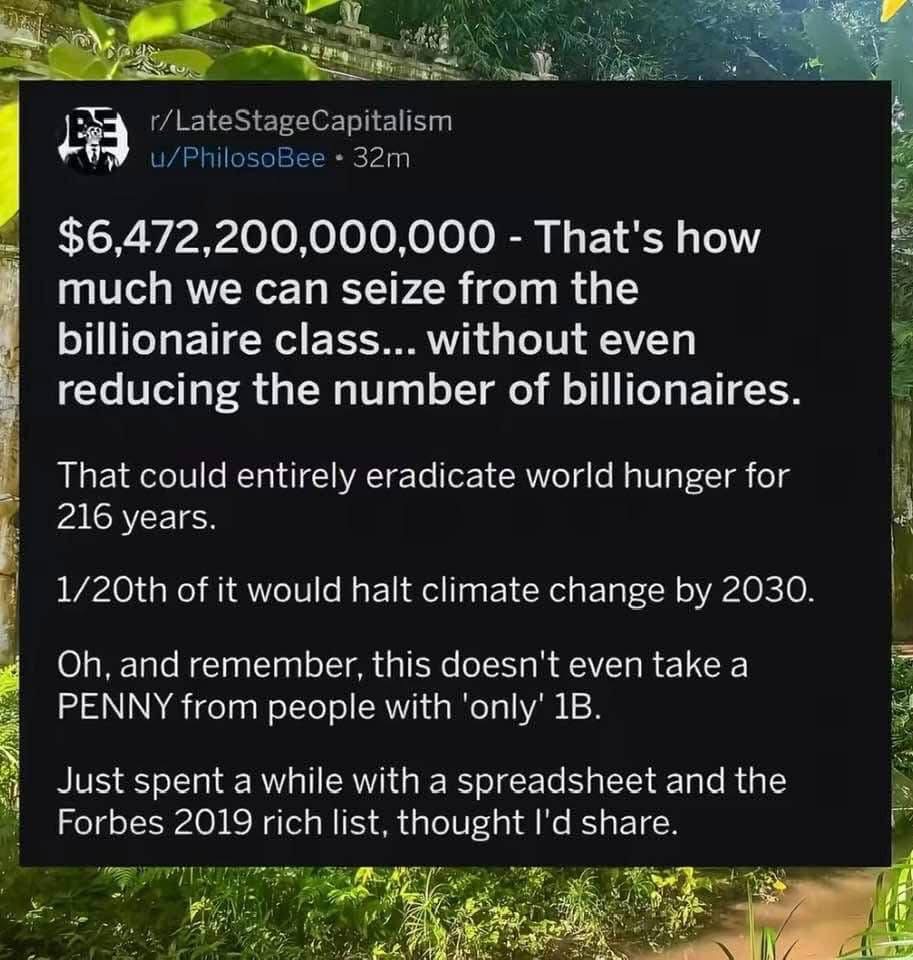
Is the above information not rather frightening? Does it not go to show how much unfettered greed has hurt the progress of the human race?

Let’s look at this again, from the 2024 Forbes Rich List. The top 10 billionaires could contribute $1.542 trillion to various causes, and all would still be billionaires. If you add billionaires 11-20 to that list, you have a pot worth $2.459 trillion.

To place this into some context, the charity UNWFP estimates it would cost $40 billion a year to end world hunger by 2030 (based on an article written in 2022). That’s $320 billion, or just under 21% of what the world’s ten richest people could achieve, if inclined to be altruistic. It’s 13% of the top twenty, to add some additional context.

What about other social problems, such as homelessness? A 2021 HUD article estimates that it would cost $20 billion a year to end homelessness in the USA by 2030. considering eight of the Forbes top ten billionaires are US-based (14 of the top 20), it seems like the money is there, no? Keep in mind, I am basing these numbers off the top 20 billionaires on the rich list, there are many other billionaires on the list, so the funds, assuming we left each billionaire with $1 billion, would in fact be even greater.

To look at this another way, the top 1% have more wealth than the bottom 95% combined.

Now, some people might say ‘Ben, these people earned their wealth, it is unfair to take it away, least of all to untrustworthy governments’. The thing is, these people often haven’t earned their wealth. No one earns billions of dollars. A lot of people working for these multi-billionaires are why there are billionaires; that, and inherited income, rafts of lawyers striking deals, and other, less intensive means of ‘work’. I don’t doubt the ingenuity of some billionaires, but to pretend they are self-made, or that they work as hard as those under them, is to be ignorant.

Is it fair to take away their wealth? Well, the very people who would say it’s unfair are people who rather ironically, are either the extremely wealthy (who naturally don’t support doing anything that might slightly impede their wealth), or those who are heavily indoctrinated to both distrust the government, and paradoxically trust the wealthy. No one particularly likes taxes, but how else would we fund important infrastructure? Do people want functioning roads, emergency services, water and power? Do people want schools and hospitals and railways? By what mechanism would these be funded, if not via taxation of some form? Should we rely on the altruism and charity of the wealthy?

It is painfully obvious that to rely on the generosity of people like Elon Musk would be a form of folly. Musk has comfortably demonstrated that he is in it for himself. The same is true of most of these super-rich types. They look after themselves, and have little to no interest in doing anything for the benefit of others, unless it also somehow benefits them. The expectation that we can rely on charity to handle problems of global poverty, homelessness, hunger and disease is a fantasy. The concept of trickle-down economics filling the coffers of the working class has never come close to coming true, in all the decades that the idea has been bandied about.

Why do people choose to trust these billionaires, more so than they would trust their own government? Who do they think billionaires work for? The average person? Clearly not. They horde wealth for the sake of it, whilst others – sometimes their own employees – cannot put food on the table, or pay for expensive-but-vital medical treatment. Worse, they manipulate others into thinking this is somehow a good thing, that the accruement of money is a virtuous pursuit, even if others have to fall by the wayside to do so. This is not to say that entrusting anything and everything to government hands is wise, or even necessary, and the quality of governments certainly vary. Some I would trust more than others. I certainly do not trust billionaires to act in my interests, and I am baffled that anyone would believe otherwise.

Back to The Thinking ‘Kat

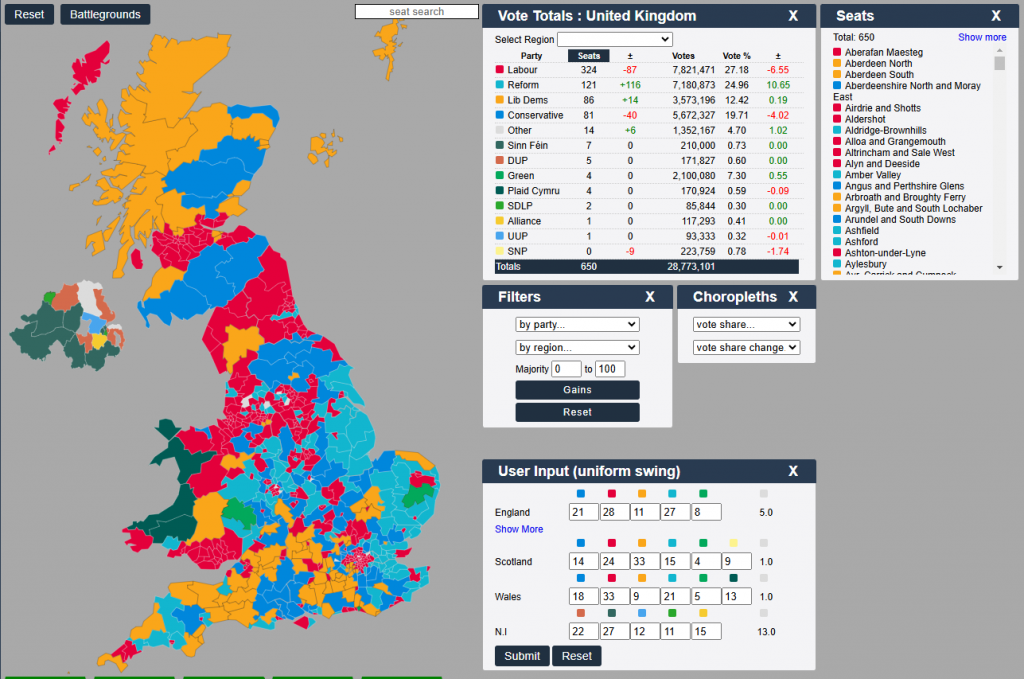
The above map would be the political state of the UK, if we held a general election tomorrow. It makes for a grim image, because it shows a surge in support for a political party that is in fact far from suited for power, and all about dividing people.

Reform have enjoyed a lot of support in the past year, but this is down to a load of hyperbole. Party icon Nigel Farage has never had the interests of the UK at heart, and he loves to play the immigration card at every available opportunity. The concept of ‘othering’ people is as old as time itself, and it is a smokescreen, nothing more. Unfortunately, fear is a powerful motivator, even a false fear, created for political gain. Immigrants are so often scapegoated, and it is no different in this scenario.

Now, in this scenario, Labour would still have a majority of seats, but not enough to form a government. They would have to enter into a coalition, with either the Liberal Democrats, or the Tories. Since the Tories have been an utter shambles for over a decade, and since they are ideologically opposed to Labour, this would be an unholy alliance that would never work. The Lib Dems are closer to Labour in terms of policy and values, though the two parties certainly have their differences.

What troubles me is that so many Britons are being seduced by Farage’s ignorant spiel. Remember, this man campaigned for Brexit, and Brexit has proven to be an unmitigated disaster. He’s meant to be an MP for Clacton, but he’s been jetting off to the USA every five minutes, thus being absent from his station. He has hilariously gotten into a spat with Elon Musk, a case of far-right fools eating each other for glory and status. His ‘policies’ are vapid, empty, hollow pieces of posturing, designed to foster continued division. My sincere hope is that the people of the UK wake up to his poisonous reality, and reject Reform’s dangerous, self-serving message. We shall see.

Back to The Thinking ‘Kat

Episcopal Bishop Mariann Edgar Budde spoke truth to power during a sermon delivered at a prayer service attended by President Donald Trump, Vice …

Washington D.C. Episocopal Bishop Mariann Edgar Budde Speaks Truth to Power, and President Trump is Pissed

It’s time for the second reblog of 2025, and the second reblog from The Life and Times of Bruce Gerencser. My friend has spoken of the words of Bishop Mariann Edgar Budde, who performed an important duty on behalf of those so often marginalised by hard-line right-wing conservatives: she spoke to truth to power.

It goes without saying that her message was not warmly received by Trump himself, nor his worshippers followers. It seems to the hardliners, the mercy and love they speak of is both something they do not themselves understand, and do not extend to those they deem unworthy. It has long struck me as ironic that the most outwardly passionate firebrands are the ones least inclined to actually honour the teachings they claim to love. In the case of Trump, he does not even manage to claim to love the core teachings of Christianity, much less actually come close to honouring them, yet he is virtually treated as a saviour in the eyes of diehard evangelicals and conservative Christians.

This baffles me. Never has a man been less like the Christ of the Bible. His policies – which will hurt people in various ways – are hardly beacons of love or mercy. If Jesus returned to the world tomorrow, preaching similar words to that of Bishop Budde, it seems clear he would be derided by modern-day conservative Christians. It seems the truth is hard for some to hear.

Back to Meerkat Reblogs

Donald Trump and his bootlicking administration is going to kill us all.  No, friends, that is not hyperbole, that is fact supported by evidence. The…

Killing. Us.

It’s time for the first reblog of 2025, and it comes curtesy of the wonderful Jill Dennison. Her potent, powerful post passionately points out the perils of abandoning long-standing policies of reason and logic, for a set of ‘policies’ that almost seem designed to cause grief and strife. Why else would Trump direct the US to leave the World Health Organisation, or enact policies that will keep people in the dark about disease outbreaks? Why else would he nominate an anti-vaxxer to become health secretary?

This is madness, but madness is something Trump both cultivates, and embraces, and if there should be terrible consequences for everyone else… well, Trump’s endgame is that he gains power and fortune for himself and his cronies, everyone else is a mere stepping stone on the way to that goal. He will be viewing these actions as beneficial to him, and that’s who always comes first in his world.

Back to Meerkat Reblogs

Time for a discussion of what can be a challenging topic. Autism is a condition that impacts a person’s ability to communicate and socialise, and it tends to lead to repetitive behaviours as well. There can be sensory factors as well; some autistic people react badly to the sensation of certain clothes, or the textures of certain foods, as an example.

There are degrees of autism, with some on the spectrum not even being capable of verbal communication. Others are capable of masking their autism, though not always without challenge.

It’s a sensitive subject. The difficulties with social settings can make it appear that an autistic person is aloof, cold, blunt, and awkward. Prior to a diagnosis, this can make life difficult for everyone involved, especially so for children. As someone who is familiar with autism, I will say that patience is a must, and so is showing love, as much as possible.

I come from a place of sympathy, due to my own brain chemistry. I have dyspraxia, a condition that affects concentration and focus. This manifests itself as a sort of constant, skittish thought process. I can trace this as it happens, by thinking a particular thought or notion, and within five minutes, finding myself at a completely different place. For example, I could be thinking of Formula 1, and within five minutes, whatever thread I was following will have become a meandered take on whether or not ants would like cheese.

Despite the emotional and social challenges of autism, many of those on the spectrum are fully capable of learning, and of developing social skills. Autism does not have to hold a person back, and some actually go as far as to embrace their unique neural situation. Acceptance for who we are is often all any of us want, and autistic people are no different in that respect.

The flipside to this is that autism cannot be wielded as an excuse to wave away any and all forms of negative behaviour. There are those on the spectrum who are fully able to understand what is and is not acceptable conduct, and yet they may choose to be belligerent. I’ve encountered this first-hand, and it can be observed in some high-profile figures too.

As an example, take Elon Musk. Does his autism excuse his behaviour, in part or in full? Can it excuse some behaviours, but not others? He recently gave what certainly looked like a Nazi salute at Trump’s inauguration, and since the gesture is one widely associated with the Nazis, it seems hard to fathom that Musk could be unaware of its symbolism and meaning. Autistic or not, is any justification for using that gesture? Musk a learned man, so he cannot fail to know how it looks, and between this, and his growing association with hard-right and far-right political entities, to what degree can he – or anyone on his behalf – hide behind any aspect of his life or self?

I think what I am broadly trying to get at is that autism should be not treated as a stigma, nor a taboo subject, and it is important to understand the value of patience with those who are on the spectrum. Intolerance is not going to garner any benefits, though the patience does have a few caveats. Speaking from direct personal experience, you can still, where appropriate, discipline someone who is autistic, and someone who is autistic can still respond well to that. If there was ever an area where understanding nuance and individuality was important, it is how to make neurodivergent people feel accepted and welcome in society, and that includes, where possible, helping them to understand what is and is not unacceptable conduct and behaviour. It should go without saying that Nazi salutes are not acceptable behaviour, and there’s no conceivable way Elon Musk in unaware of this.

Some people might say ‘it wasn’t his intention’ to do a Nazi salute, and that this should exonerate him, so to speak. There is only so far a reasonable person can take this logic. You might not intend to cause offence if you call someone ignorant, but you can assured that no one will particularly appreciate the comment, and where gestures from a party with a history of terrible, evil deeds are concerned, you can assured it will offensive, and rightly so, to a great many people. Intent matters, but so too does common sense, and awareness of the consequences of one’s words and deeds. Again, autism can only shield Musk so much from those consequences.

I don’t know if I’ve put any of my thoughts up in a coherent manner here, but it’s something I wanted to get off my chest. There you go.

Back to The Thinking ‘Kat

As part of my on-going efforts to be a multi-channel meerkat, I present my latest thoughts in video form! Hopefully, you can tolerate my voice…

If watching a video is not your thing, then I’ll briefly summarise: in short, I am gravely concerned at Mark Zuckerberg’s decision to stop fact-checking what people post on his social media platforms. The only people who benefit from this are the ones who are currently lying, and you don’t need three guesses to work out who those people are. This is a move designed to support Donald Trump, and other hard-right conservatives. They are the ones who have whined the loudest about fact-checking, because they are the ones who lie the most.

Since it is about to become acceptable to deceive on Facebook, Instagram and Threads, it falls to the regular people to police both themselves, and those who lie to us. All we can do is try.

Back to The Thinking ‘Kat