In a prior post, I wrote of where I sit on the political spectrum. In that post I referenced the privatisation of public services, and why I believe this to be a bad idea. In this post, I aim to expand upon my reasoning. I will be paying a particular focus on the United Kingdom, where governments have privatised a number of public services, with what I consider to be disastrous results.

The Railways

By Hugh Llewelyn – 91 101Uploaded by Oxyman, CC BY-SA 2.0, https://commons.wikimedia.org/w/index.php?curid=24385164

Back in the 1990s, the UK government of the time – John Major’s Tories – set about privatising the British railway network. British Rail became Railtrack, who were responsible for the tracks, signals and general infrastructure, whilst TOCs – train operating companies – took over the duties of scheduling, running and maintaining the trains themselves. Different companies bid for the right to run services, and it was expected that they would fight hard to perform to a high standard, lest they risk losing their franchise. Of course, what happened is that corporate greed inevitably reared its ugly head.

In 2002, a high speed train derailed near the town of Hatfield in Hertfordshire. I quite vividly remember this, for I was due to get on a train to London, via that section of track, the following day. The crash caused four deaths, injured many more, and it brought into sharp focus how poorly Railtrack had managed the railways. The derailment was the result of a cracked rail, and it was soon discovered that Railtrack had been aware of the problem. Poor management, and the excessive use of out-sourced contractors, along with poor communication, meant the tracks were not replaced, and Railtrack had no idea how many other weakened rails were out there. A hasty program of repairs was started, but this incident proved to be the end of Railtrack, and the government took back control of the railway infrastructure.

Successive TOCs have faced financial problems, and required the government to bail them out of trouble. In some cases, some TOCs have transferred back to public hands, due to woeful standards of performance. The cost of train fares has risen twice as fast as wages, services are inconsistent, the ticketing system is horribly complicated, and Britain’s railways are noted for their considerably inefficiency when compared to elsewhere. There is an excellent post on the subject here.

Water

The privatisation of this particular key service has not just been an example of cost-cutting corporate greed, it has also demonstrated that public health can be placed at risk. Whilst water companies pay out huge sums of money to shareholders, infrastructure is creaking, customer bills are rising, and untreated sewage is routinely making its way into Britain’s rivers, lakes and beaches. To add insult to injury, water companies were debt-free when privatised, yet have since taken on £60 billion worth of debt, whilst investors have withdrawn £85 billion in shareholder pay-outs.

It is absurd to think that the problems water companies face can only be dealt with by charging customers more. Ceasing these pay-outs and using that money to cover the costs of faulty infrastructure would be by far the best course of action. Once again, you can find a great article on this here.

Energy

In the 20/21 financial year, Britain’s top six energy companies recorded more than £1 billion of profit between them, right before Britain’s energy markets went into crisis mode. In 2022, BP alone recorded profits of £7 billion, at at time when consumers faced bill increases of up to 250%. As with water, energy infrastructure has lacked investment, shareholders are benefiting enormously, and it is left to the public to foot the bill. You can read more about this here.

Why Privatise?

The theory behind selling off public services – aside from the initial injection of cash it gives to public coffers – is that a competitive market in any given field will yield better results. A company that under-delivers or is over-priced will either have to improve, or it will fall by the wayside, with another business stepping in or taking over its share of the market. The grim reality is that these three key public services have all suffered, and consequently so has the British public. Corners get cut, shareholders take priority, and because a number of these companies have needed to be bailed out over the years, the cost to the public is actually even higher. There has been no tangible benefit to privatising these services, unless you happen to be an executive within them, or you are a shareholder.

The key element to remember is that public services are often crucial. A good transport network is pretty important to a country. Water and power are certainly vital. This is not like two rival companies that are both designing and selling computers, or TVs. If a water company fails to properly execute its duty of care, people can get sick, and potentially even die. If railway companies do not do their jobs properly, people can die. If energy companies do not discharge their responsibilities correctly, people can die. Placing profit ahead of public interest inevitably leads to cost-cutting, and corner-cutting. This has been demonstrated time and time again, so I hope, with this in mind, that key public services come back under public control, sooner rather than later.

Back to Deep Meerkat Thoughts

When I was in my early twenties – some two decades ago now! – I never thought I would wind up with a tattoo. The act of letting someone repeatedly pierce your skin with a needle, firing ink into your flesh to leave a permanent feature on your body… I can’t say the idea was seriously on my radar. That changed around ten or so years ago, when I was persuaded to get my daughter’s name tattooed on my arm. Once I had done this, I found myself weirdly attracted to the idea, and would get a second tattoo soon after, this time about Star Trek.

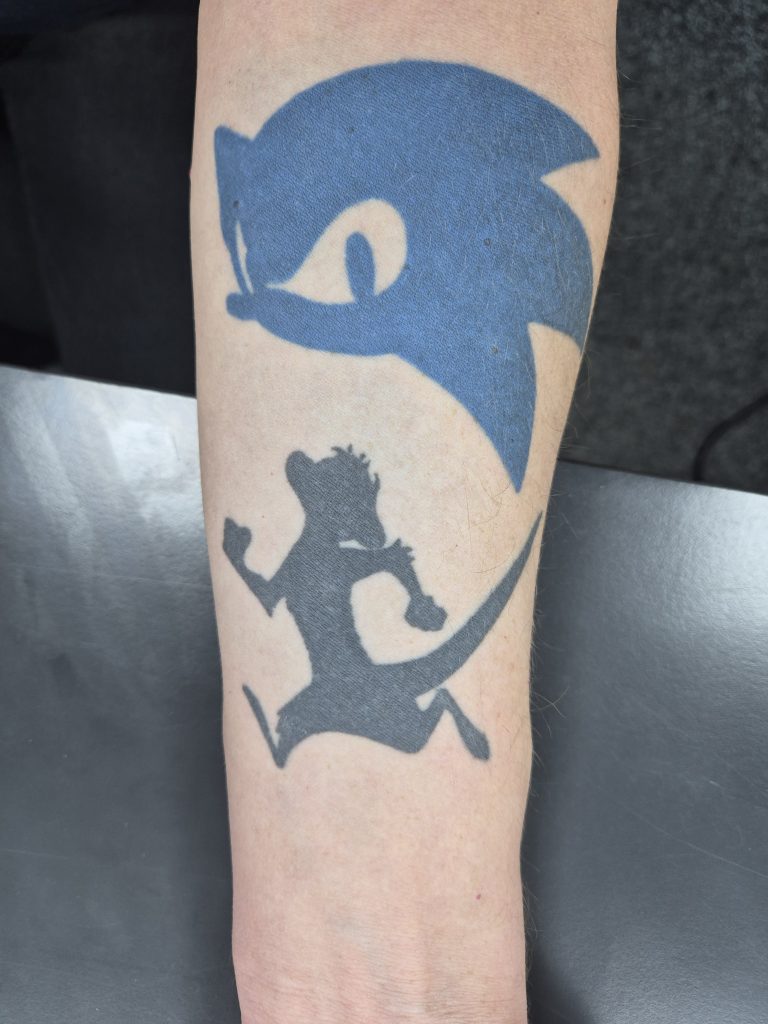
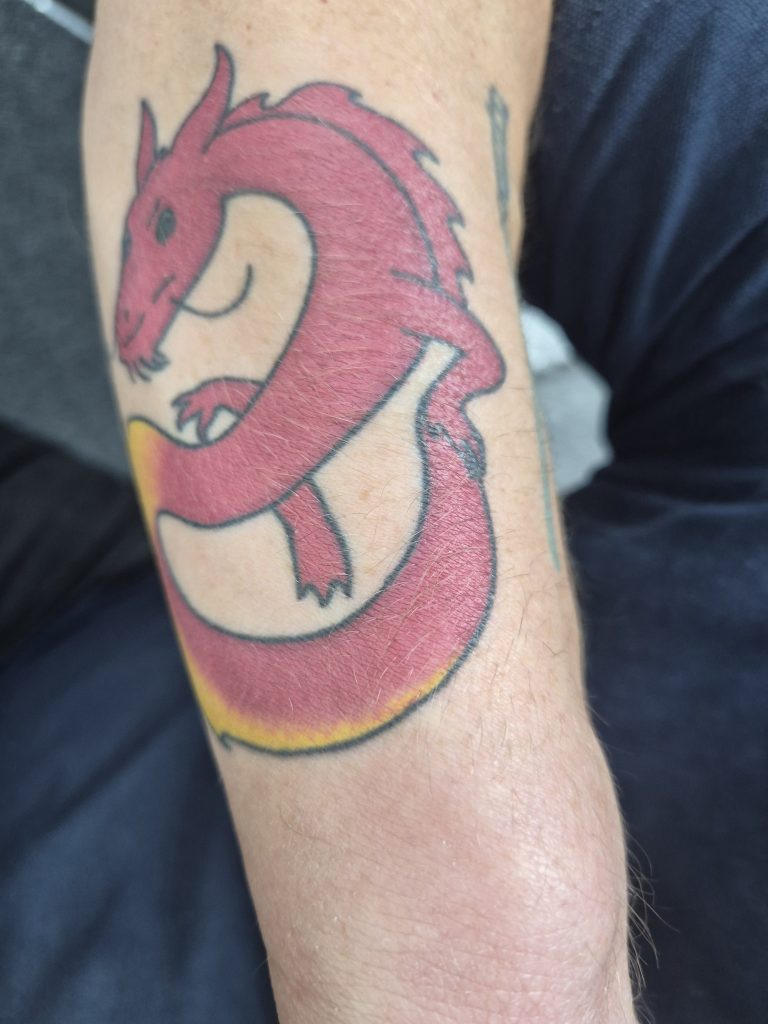
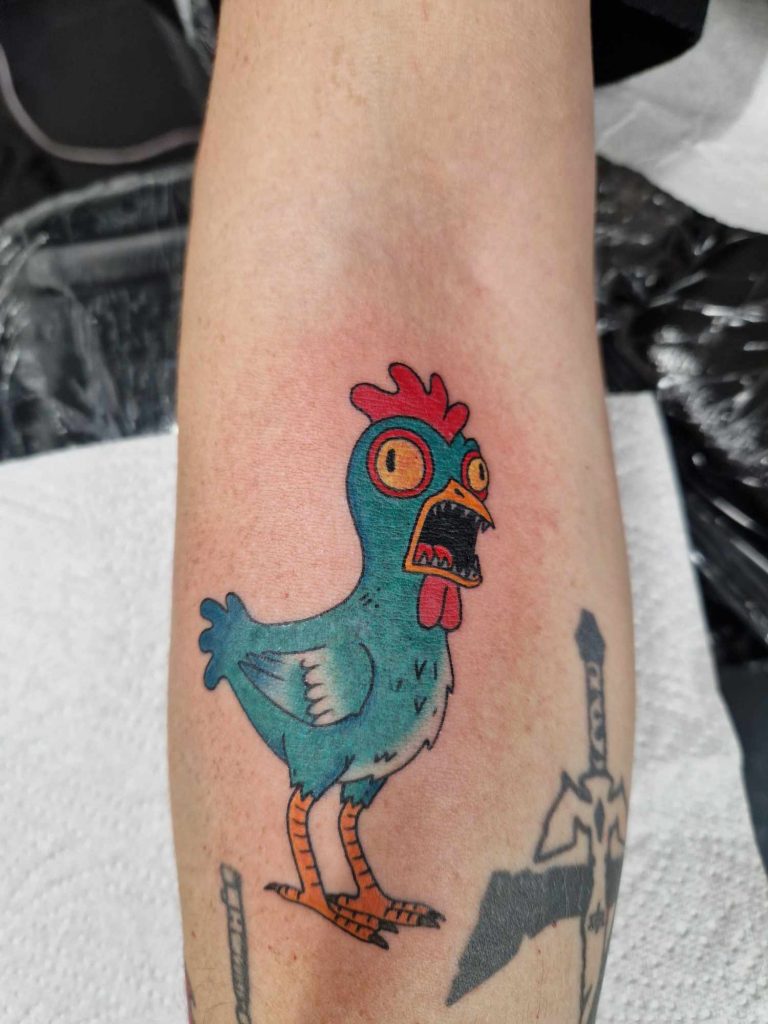
Down the years I have ended up with a grand total of 13 tattoos, at the time of updating this post. Each represents something of meaning and enjoyment to me. There is Timon, there is a question block from the original Super Mario Bros game, I have a lightsaber, a Legend of Zelda tattoo inspired by Breath of the Wild, there’s Sonic the Hedgehog, I have Scrooge McDuck from the 2017 DuckTales reboot, and a dragon drawn by my daughter, to refer to some of my tattoos.

I am immensely proud of all of them, and I have a desire to get more. The pain is not an issue, though yes, tattoos do hurt, and they can feel uncomfortable for a few days afterwards. The single biggest factor is money! Tattoos are not particularly cheap, even for something relatively simple, so if you are considering one, be sure to bear that in mind. As for the pain, placement tends to drive that. All my tattoos are on my arms, and on the fleshier bits at that, but I am told tattoos on bonier points hurt more.

An early pic of my Scrooge tattoo.
A clearer pic of my Zelda tattoo.
Timon and Sonic.
It’s not the clearest pic due to the angle, but this is my 10th tattoo, a picture drawn by my daughter.

What I admire about tattoos is that they truly are art. They are not for everyone, for various reasons, but those who want them can use them in wonderfully expressive ways. The body becomes a canvas, and the tattooist is the painter. The talent required to do a tattoo and do it well is something I find quite envious! The design also reflects upon the person being tattooed. People are always thinking of new, imaginative ideas for tattoos, and I would like to think some of mine are pretty unique!

The question I currently face is ‘what to do for tattoo number 13?’ I have a number of ideas in mind, including some relating to Formula 1, but for me, a tattoo is a carefully considered decision. After all, they are permanent, and expensive! I doubt I will ever impulsively wander in to a tattoo parlour and choose something, there and then. That’s my personal philosophy with tattoos, but each to their own. I would always caution, um, caution, but everyone has to make their own choices as to why, how, and where they get a tattoo!

Back to Meerkat Prompts

Down the years, I have written a lot of material about feminism. The movement to ensure better standards of equality for women has seen a lot of chances, and a lot of challenges, and there are differing opinions within feminism as to what the aims are. I may visit some of that in the future.

I have also had a number of arguments on the subject. Most of these have been over at the Coalition of the Brave website, where my views and opinions earned me the wrath of MGTOWs and MRAs, acronyms I will explain later on. Suffice to say, discussions around women’s rights can heat the blood, so to speak, and there’s a lot of passionate debate out there. In fact, it’s difficult to know where to begin, but begin we must, so let’s get to it…

Defining Feminism

According to the Britannica Dictionary, feminism is defined as ‘the belief in social, economic, and political equality of the sexes. Although largely originating in the West, feminism is manifested worldwide and is represented by various institutions committed to activity on behalf of women’s rights and interests.’ Under this umbrella there are different forms of feminism, and some of them reinterpret these goals.

For example, radical feminism holds to the idea that society needs to be completely reorganised, with any and all power structures granting men power other women requiring dismantling. Liberal feminists argue that women should have the same social, economic and political power as men. I guess a simpler way of defining these two forms of feminism is that liberal feminists seek equality within the system, and radical feminisms seek equality by destroying the system.

In some cases, there are feminists who want absolutely nothing to do with men at all, or they will argue that feminism ideology cannot be achieved through the involvement of men. Other feminists will argue that men need to be engaged with, in order to shift perceptions and achieve change.

So, already you can see there are differences in approaches, and even philosophy.

Don’t we have equality already?

Some might argue that in general terms, we already have equality of the sexes. Women are free to pursue the same careers and opportunities as men in most western cultures. There remain parts of the world where this picture is very different, and modern feminist beliefs clash with traditional cultural beliefs. In some countries women are very-much second class citizens, and changing this is very difficult, due to deep, traditional dogma.

Even in the west, there are still plenty of reasons for feminism to remain an active movement. Whilst the gender pay gap has decreased steadily in the UK, it still remains. There is still a gender pay gap in the USA. This is true for much of Europe as well. It is rather absurd to pay people differently for the same work, based on their genitalia, but here we are in 2023, and this is still the case.

There also remains a lot of latent misogyny and entitlement. According to this article, four out of five victims of stalking are women, and men are more likely to be the ones doing the stalking. Men are more likely to be randomly aggressive to women on the street (something brought home to me in vivid detail, when my wife was randomly screamed at by a male teenager, for doing nothing more than walk by him). Women remain considerably more likely to be victims of sexual assault, and men are overwhelmingly the perpetrators.

With these facts in mind, it is clear there is certainly a need for feminism, so why do some people resist the idea that feminism is necessary?

The Opposition

I referenced MGTOWs and MRAs earlier on. These groups tend to be passionately opposed to feminism, but what are these groups, and why are they against feminism?

MGTOW stands for ‘men going their own way’. What has often happened is that man feels wronged by women in some way, and they declare their intent to not have any involvement with the opposite sex. In my experience, MGTOWs speak of having nothing to do with women, but in practice want women to listen to them, and be available to them on their terms. MRAs are ‘men’s rights activists’, who rarely if ever actually seek to look after men’s rights.

The best – or worst, depending on your point of view – of my experiences with MGTOWs was via the Coalition of the Brave. You can see a ‘conversation’ with them here (I should add a content warning, considering his tenor, statements and language), and another ‘discussion’ here. There was a lot of rage here, and in my view, so much of it was horribly misplaced. This is largely because MGTOWs and MRAs have no understanding of the root of the problems they complain of.

You see, these groups believe feminism is about demeaning men. They speak of a culture of favouritism within family courts, which historically sees women win most custody battles. They cite how men tend to do the more dangerous jobs. They note that men are more likely to commit suicide. What none of them usually consider is ‘why’. They have collectively had a kneejerk reaction to feminism, as though somehow these long-term, historic problems are the fault of feminism. Instead, these problems are down to the very things feminism opposes, which is stereotypical gender roles.

Family courts tend to award women custody not because of feminist influence, but because the traditional, patriarchal view is women make better caregivers. It’s true that men tend to do the more dangerous work, but it’s also true that women have historically been barred from certain fields of work, and at one point, weren’t allowed to have jobs at all. Again, this is due to old-fashioned expectations, something feminism opposes. As for male suicides, why aren’t MRAs doing more to encourage men to speak up and speak out about what is troubling them? Why is this anything to do with feminism?

Let’s leave this post with some places that can offer support to women. Firstly, the following link was provided to me via email, from The Online Protection Alliance. The Empowering Internet Safety Guide for Women offers guidance and ideas to women (and men can use these tools too) to protect their identities and stay safe on social media. There is also a resource to be found here, for anyone who needs help escaping from domestic violence, with contact numbers with a global reach.

There you have it. You have my thoughts on feminism.

UPDATE 18/11/25: I’ve been asked to share a link to Cyber Ghost VPN, regarding the dangers of doxxing. Doxxing is an oft-malicious practice that involves sharing people’s private information without consent. This can affect anyone, but for the purposes of this post, it can be used by aggressive and insecure men to harass and demean women. Everyone can benefit from knowing what to do if they think they’ve been doxxed.

Back to Deep Meerkat Thoughts

What’s something most people don’t know about you?

Hmm. I suspect most people don’t know I once held a world record! It was nothing major, and the niche is quite limited, but nonetheless I briefly held a time-trial world record for the first circuit of the PAL edition of Super Mario Kart.

Since I set it, others eclipsed it, particularly with a sort of jump technique that granted good speed over normally slow terrain. I never mastered this skill, so my record is basically a ‘traditional’ one, set by seeking as much as speed over the track itself. I managed to set it by sheer perseverance, relentlessly playing the level over and over again, seeking to nail each lap as perfectly as humanly possible. My initial reason for this was a bit of friendly rivalry with a friend, who was also setting some insanely fast times. These days, this old greymuzzle’s reactions are not what they used to be, and I doubt I’d get anywhere close to my old speed, let alone threaten the current world records.

You may be wondering what I mean by the PAL edition, and this is to do with the differences between US and Japanese/European hardware. Back in the days of the Super Nintendo, there were different standards of frame rates, the PAL standard and the NTSC standard. To cut a long story short, these differences affect the fastest possible achievable lap times on Super Mario Kart.

Below, I present to you the current world record for the PAL version of Super Mario Kart’s Mario Circuit 1. I am quite jealous!

Back to Meerkat Prompts

Politics drives a lot of the forces in our lives, whether we know it or not, or whether or not we care to acknowledge it. Decisions taken in the halls of power cascade downwards, carrying with them a torrent that can sweep away what was once certain. This is not always a bad consequence, but then again, your mileage will vary. One person’s pleasure is another’s pain, and what you regard as a good political choice will also vary, sometimes quite wildly.

For me, I am quite prepared to state I fall on the left of the political spectrum. I think for-profit healthcare and education models are too-easily disrupted by greed, and the proof of that can be seen in some of the systems in place outside of the UK, as well as within. Privatising everything tends to lead to companies doing what they can to cut corners, or exploit their customer base, and there have been times this has led to awful, tragic consequences. This is not to say that government-run institutions do everything perfectly, which is why I have no issues with the option of private education, health, transport etc. However, entrusting public services solely to corporate interests tends to backfire.

Such statements on my part might – and have – led to the suggest I am a socialist. I dare say I have socialist leanings, but to be clear, I do not advocate for full-scale socialism, and certainly not for communism. These are buzzwords, used to create a bit of hysteria, but often inaccurately used by people who make assumptions about what socialism and communist look like. I have heard the expression ‘Liberal Democrat Marxists’ in respect of the USA’s Democrat Party. In reality, they are barely left-wing at all, especially in comparison to left-wing parties in Europe, and even more so in respect of far-left regimes like those found in China and North Korea.

The fear-mongering is a smokescreen, nothing more, but it is a very common trick in politics, employed by both sides of the political aisle, and unfortunately a lot of people get fooled by it. In some parts of the world (America, I am looking at you), people are so entrenched in their positions, that merely implying someone is a socialist/communist is enough for others to believe it, without doing any critical thinking. There is also the knee-jerk belief that drifting even a little to the left is going to lead to a draconian dictatorship.

I obviously cannot speak for everyone who identifies as left-wing, but for me, my values are as follows. I believe that organised religion should not be what leads policies in a secular state, especially where the rights of women, the LGBT community, and racial minorities are concerned. I believe that important public services should never be solely in private hands, for the reasons detailed above. I believe there are enough resources in this world to ensure that no one – especially in affluent first-world countries – should be homeless, or forced to choose between heating and eating. What holds us back from resolving these problems is nothing more than pure, unchecked greed. It is one thing to see to earn money, and I heartily respect people who look to better themselves, but when the Elon Musks and Mark Zuckerbergs of this world horde unimaginable wealth, gained off the backs of people working far harder than them (people who often live paycheque-to-paycheque), there is clearly something painfully flawed with the system.

There is a certain irony in how a lot of conservatives, especially religious ones, speak of individual rights, yet would slave millions to a heavily capitalist system, and also to a system of ‘rights’ that would actually erode rights for millions, through favouring specific religious and cultural beliefs. Indeed, there is arguably more demand for conformity within the political and social right than there is the left!

So there you have it. This is where this meerkat stands.

Back to Deep Meerkat Thoughts

Time for a bit of shameless self-promotion, because hey, why not? Back in 2022, after a process that began life in 2019, and following a lot of work, both on my part and that of my wonderful publishers Jumpmaster Press, I realised something of a dream of mine.

The Awakening marks my first traditionally-published book. Don’t get me wrong, I think self-publishing is absolutely a valid form of publishing, but to have a publisher read my work and decide they wanted to put their name against it is a pretty special feeling. You’ll notice there is a link to your left to the book, if you wish to order it (cheeky hint!).

It was quite the process, writing this story. It certainly evolved over time. It began life as The Warlord, and the original incarnation went off on some very different tangents. I learned – thanks to some good advice – to focus on showing the story instead of telling it, and I learned what the traditional conventions of storytelling are (as well as when to break them). I owe a lot of people a lot of thanks for having patience with me as I went through this journey.

What is The Awakening about? It follows the story of Seluban, a warrior serving the Chon’ith Empire. He comes to a revelation about his rulers, but before he can act upon it, he is turned into a scapegoat and banished to Coward’s Forge. From this inhospitable wasteland, Seluban must find the courage to carry on, and escape so he can save his people from within, before a powerful new enemy destroys them all.

It goes without saying that I am extremely proud of this endeavour, and should you read it, I hope you enjoy it! There is a sequel on the way, The Schism, tentatively scheduled for some stage in 2025, so maybe that will serve as a tempting hook!

Back to Meerkat Prompts

Earlier this year, my wife, daughter and I, along with my parents, my brother and his family, enjoyed a holiday to the sunny Italian island of Sicily. The weather was beautiful, the food was quite frankly amazing, and the trip was much-needed. It was also a horribly early start on the day we flew, but that’s life!

My dad took this lovely pic of the hotel pool.
He also took this pic from the beautiful old town of Taormina.

For those of you unfamiliar with Luton Airport, it would be fair to say you aren’t missing much. We got there at around 4am, for a 7am flight, and dealt with all the usual rigours of air travel. This meerkat does not mind flying to a point, but I will confess that as I get older I get more anxious about it. The check-in and security stuff at the airport doesn’t heighten my nerves, but it doesn’t soothe them either. Ultimately it’s faintly ridiculous of me, because flying is statistically the safest form of travel, but there’s always a twinge of worry about being so high up in the air in a pressurised tube for any length of time. Mind you, the flight did give me the chance to take some spectacular aerial pictures:

The view of the mountains was unrivalled.
Mount Etna casts a powerful shadow across Sicily.

So, onto the trip. The first thing we did when we reached our hotel, a lovely resort called Hotel Caesar Palace, was grab some lunch, as we arrived just in time for it. As is rather normal for hotels of this nature, it was a buffet, with various options, and these options got rotated across the course of the week. There was always something interesting and fresh, and given Sicily is an Italian island, there were plenty of pasta options!

There were plenty of amazing dessert options!

As is befitting a Mediterranean holiday, we spent a fair bit of time poolside, and in the pool as well. I for one certainly appreciated the opportunity to regularly cool off, considering the impressive 30C+ temperatures that we encountered, every single day! In the evenings my wife, daughter and I largely withdrew to our room, as the night life was quite loud, and my daughter in particular does not care for loud noises. Still, we did occasionally venture out, and we all took full advantage of the all-inclusive drinks!

It goes without saying that we did not confine ourselves to the hotel. On a couple of occasions family trips were had to the nearby town of Naxos. Here I scooped up some souvenirs, and we also took a couple of trips to the beach. Mediterranean waters tend to be amazing, and the beach here was no exception. Crisp, clear blue sea met with white sandy beaches, and I had a couple of swims in the serene waters. Somehow, it always feels more refreshing than a hotel pool, though there’s always the question of sand in awkward places afterwards!

Did I mention the desserts were great?

A couple of trips stand out. Firstly, we all took a visit to the old, rustic town of Taormina. This involved a winding bus ride up a hill, and more than once I was left to wonder how the driver managed to navigate the twisting roads, but he managed, and we arrived safely! Taormina is a stunning town, filled with reminders of European history, and also home to some very impressive, very expensive shops. In fact, at least one shop had an armed security guard outside, to emphasise just how expensive it was!

How’s that for a view?
The history of the town was evident everywhere we went.
Sicily’s strong Christian roots could be seen all over Taormina.
Authentic Italian ricotta ravioli!
Great care was taken to ensure shops looked appealing.

The other trip that will live in my memory is the dolphin spotting. My parents opted out of this one, but the rest of us made our way to Naxos, where I was expecting a different kind of boat! We stepped onto a glorified inflatable, and guess which unlucky meerkat did not get a proper seat?! I was perched on the side, assured I was perfectly safe, but on a fast, bumpy boat like this… I clung on to the bars pretty tightly!

Did we see dolphins? Yes, though getting pictures of them was tough. As you might imagine, they tend to leap in and out of the water whenever they like, and do not pose for photos! Still, it was quite incredible to see dolphins – which I consider to be remarkable and beautiful animals – in their natural element. I’ve swam with dolphins before, in a controlled environment in Portugal, and that will always be a treasured experience, but seeing them in the wild is something else.

As it did from pretty much everywhere, Mount Etna loomed large in the distance.
A rare picture of me in my human form! Yes, it’s a Timon t-shirt, and yes, the yellow with yellow is intentional.

Afterwards my brother’s family and mine went to a nearby restaurant, and I gauged myself on pizza. Did I mention the food by the way?

Oooh look, more hotel desserts!

Some final pics:

One day, it looked like a Greek arch was growing out of Etna herself!
Do you want pasta? Italian supermarkets are devoted to it!
Everywhere you went, the view was gorgeous.

The most telling way to answer if a holiday was good or not is to ask ‘would I go back?’ In the case of Sicily, the answer is a clear and happy yes! Thus concludes this meerkat’s Italian adventure 🙂

Back to Meerkat Prompts

Time for another revived post, and one inspired by my pal Bruce Gerencser. I had once written a post that delved into discussions of modesty and lust, and two years later, these topics remain pertinent. A recent discussion over at Insanity Bytes highlighted – for me at least – how there are some… let’s just say unusual takes out there. The original post that Bruce referred to has been deleted, but thanks to the Wayback Machine it can still be found. For the moment though, let’s consider this subject in more general terms.

Modesty

To be modest in the sense of this post, I am speaking of how people dress. A number of cultures – inspired by religion – place directives and instructions on people – usually women – as to how they should dress. The idea is that people – again usually women – should cover up their bodies as much as possible in most circumstances, so as not to tempt others – usually men – into sin.

What with the concept of modesty going back millennia, and being deeply ingrained on both the Christian and Islamic worlds, conventional cultural norms have told us that women are responsible for whether or not men treat them in inappropriate or even harmful, dangerous ways. It has been commonplace for judges and juries in rape cases to ask ‘what was the victim wearing?’ This should be considered entirely irrelevant, but sadly it is still something that some judges and juries are swayed by when convicting and sentencing rapists.

Through this concept comes a wider approach as well. ‘What was the victim wearing’ becomes ‘was she flirting? Was she doing something to lead her accuser on?’ These sorts of questions seek to shift the fundamental responsibility for sexual violence onto women. Society as a whole is starting to challenge this perception, but it is more of a glacial process than it should be.

There is another problem with this approach. It assumes that men are base creatures, incapable of rational thought in the presence of a woman who is even remotely showing skin. This provides another layer of an excuse to men, but is also demeaning to men as well. Apparently we are helpless slaves to our impulses, destined to force ourselves upon women who have the audacity to dress in something that hints at their skin and shape. What a great way to absolve ourselves of responsibility, and make ourselves seem hopeless at the same time.

Lust

Lust is a perfectly natural, normal feeling to experience. We all go through our adolescent years, and we all experience natural biological changes and urges. None of us are compelled to act upon them, and most of us have enough of a brain between our ears that we can control what goes on between our legs. When we are young (and indeed when we are older) we may desire sex, but this does not mean we are entitled to it, irrespective of whether we are lusting after it or not. It is up to us to control ourselves, and to not assume that just because someone is dressed in a way we consider provocative, it is an invitation for advances, or worse, outright permission to touch and grope.

Exploitation

One of the themes of Insanity Byte’s recent post was around the relationship between Democrat presidential candidate (and current Vice-President) Kamala Harris, and Willie Brown, a so-called kingmaker within Democrat circles. Back in 1994, he and Ms Harris had a relationship. There might have been genuine affection, or it might have been a case of Ms Harris being taken in by someone said to be flamboyant and charismatic. Either way, this relationship has been seized upon in certain conservative circles as inappropriate, and there has been a suggestion that Ms Harris basically ‘slept her way upwards’.

Given the general reality of the world, particularly some 30 years ago, and indeed throughout human history, and also given Mr Brown’s apparent womanising tendencies, it seems to me it’s more likely that Ms Harris was swept up with the suggestion and promise of political influence, if she got into a relationship with him. It is even still possible it was a genuine romance, that happened to coincidentally be between someone positioned to help another’s career. If we dismiss the latter, it means the former situation is one of exploitation.

It should not be a part of the world that women have to use sex in any way shape or form to reach their goals. Unfortunately it still happens, and it is entirely plausible that Ms Harris was victim of a system that treats sex as a form of currency. It is a lot rarer that men feel the need to use sex for their career advancement.

What can be Done?

It certainly seems as though Tom of Citizen Tom hints at sexual segregation as a means to solve the problems associated with sexual exchanges of power. He cites his military experience in the comments at Insanity Bytes, and cites the differences between genders, as a reason why women should not serve in combat units. Leaving aside his specific example (and leaving aside how women have historically proven themselves as competent fighters), Tom seems to lean on defined gender roles and ‘tradition’. Perhaps he views the Harris/Brown situation as a symptom of what happens when women and men work in close proximity? Maybe he thinks it is inevitable that there will be ‘encounters’ when men and women work closely, with men being led astray by the tantalising possibility of bedding a colleague? Is it possible Tom believes that men are so clouded with lustful thoughts, that they would suggest the opportunity of career advancement for sexual privileges?

Tom would have to answer those questions for himself, and to give him his due he goes on to say he does not favour the idea of generally segregating the sexes, but in the course of our conversation he did not offer up solutions to the problem of exploitation; he offered only criticism over apportioning blame, when in fact, it is merely reality that tells us men are more likely to exploit women. With that in mind, why would anyone consider removing women from the working environment? If it is primarily men who lack impulse control and good judgement, why should women be moved aside, or forced back into the stereotypical roles that many religious conservatives believe is their solemn duty?

Of course, sweeping monolithic punishments would hardly befit the real world. People are individuals, and should never be reduced to stereotypes of gender, or otherwise. It is also obviously very impractical to remove all men or all women from the working world; I doubt national economies would handle such a measure very well! The question is how to introduce or improve methods that relate to sexual misconduct in the workplace.

The bottom line would be to make sure that actions have consequences, at every level of a business or institution. Women often don’t report harassment or abuse out of fear. Their jobs, reputations and perhaps even lives can and do get placed at risk if they speak out. If they speak out, they are often implied to be homewreckers, or harlots trying to damage a man’s reputation for their own gain. Whilst some in conservative circles would argue that women lie, it is worth noting that men lie too, and women can tell the truth and not be believed, because even in the 21st Century, a man’s word means more.

‘What of celebrities cancelled over misconduct? What of woke culture and Me Too damaging man’s reputation?’

What of it? Despite the high publicity of these cases, there are countless other occasions where men stay in power, despite allegations and accusations. Look at Donald Trump. There are numerous allegations concerning his inappropriate behaviours towards women, including accusations of rape. He has been recording saying he can grope and touch women without their consent, simply because he is a star. He has admitted entering the dressing rooms of beauty pageants unannounced, catching women in various states of undress. Despite these behaviours, Trump was once elected President, which seems to prove, rather conclusively, that cancel culture is not the all-encompassing force conservatives often claim. Instead of facing consequences for his behaviour and statements, Trump got away with them. It is ironic that he is fronted by many conservatives as a beacon for their goals, when he does not respect the idea of modesty, clearly lacks self-control where lust is concerned, and exploited the young women at these pageants.

I have digressed. What can we do about this sort of thing?

Well, for one, I do not agree that a man – or anyone else for that matter – should be automatically punished on the basis of another’s word alone. Businesses – and the law – have due processes and these should be respected. That said, I do not believe we should automatically cast doubt on the victim either. We should be working towards a work where women – and also male victims of sexual abuse – feel they can come forward, without judgement or preconditions. We should not be asking ‘what were you wearing?’ We should not imply, in any way, that the victim is at all responsible for the actions of their abuser, attacker or manipulator. When we are, as a society, prepared to judge the facts and not the victim, we may find that justice is more readily attainable.

Back to Meerkat Prompts

Time for a surprisingly divisive question. For many years the Hawaiian pizza (which ironically originated in Canada) has been a staple of certain pizzerias, yet the concept of it can lead to some humorous revulsion. You see, the Hawaiian hosts pineapple, which as you know is a sweet citrus fruit. Does sweet citrus fruit have any place on a savoury dish, sitting alongside melted cheese, and sometimes ham and bacon?

Despite the concept initially seeming unpleasant, it all comes down to your personal flavour mileage. I for one actually don’t mind pineapple on pizza. Sure it could be seen as a little unusual, but there are plenty of other marriages between savoury and sweet. Candied bacon, for example. A lot of Chinese food has sweet and sour elements. Sweet chilli sauces and dips are very popular too.

This notion even gets flipped around. Chocolate needs no introduction as a sweet food item, yet in recent years it’s been combined with chilli, which is a combination I do not care for! Coffee and chocolate are also said to go together, though again, I am not fond of that.

What about you? Pineapple on pizza, sweet combined with savoury? Where do you draw the line?

Back to The Meerkat Q&A

Time to reproduce a prompt from the prior version of Meerkat Musings. It is worth noting that this appeared to cause a bit of upset last time, for reasons that are beyond me, but judge for yourself if there’s anything here to get in a twist about:

Drawing inspiration from Nesslabs, I find myself confronted by an interesting question. On the basis of personal experience, I dare say the answer entirely depends upon circumstances.

There are various reasons why someone might wish to remain anonymous online. Some of these will be legitimate, and some, not so much. The use of pseudonyms can be an expression of creativity, a persona used to explore one’s own self (Darth Timon says hi!), and sometimes it’s safer, especially when making use of a web forum or message board. After all, it goes without saying that if you use your actual name, you can leave yourself exposed. It is also worth noting that once something is placed on the internet, it never leaves. What we write about, what we make videos about, or podcast about… it is preserved. We can delete it, but various tools and means exist to recover what we believe – or hope – to be lost. Anyone who is online is leaving a digital fingerprint, so what we all need to carefully consider what we put out there, and how we do so.

In some respects, it is impossible to be completely anonymous. In order to register for legal and official services of any kind, we have to use our legal identities. However, in any other avenue, what reasons might we have to lower the veil, so to speak, and be our naked selves?

You there, I was speaking metaphorically, put your clothes back on. You know who you are.

Holding one’s self accountable for online behaviour is one reason to drop a pseudonym and act under one’s real identity. If our antics reflect poorly upon an internet persona, do we care? No one can easily hold us to good behavioural standards, and I have witnessed enough trolling in my time to know that under the cover of anonymity, people can and will be cruel and savage, and often unrepentant about it. In a way, we perhaps perceive ourselves as invincible when we act under a nickname, which gives rise to all sorts of unpleasantness. Therefore, dropping the mask, and being acutely aware that our words and deeds online can be directly attributed to us, forces us to act as we should, in the hopes that we are perceived as decent and honourable in our conduct.

Does it always work out that way? Of course not. Some people are rude and arrogant and conceited, regardless of whether they act anonymously or not. The only difference is that by acting as themselves, they are more easily accountable for their actions, something the average internet troll does not care for.

With all that said, to return to the titular question, my definitive answer is ‘sometimes’. There are times when it makes little sense to expose personal details. There are times when a person may have a genuine need to protect their identity. Exactly what those circumstances are is something we can only judge for ourselves. There are other occasions where it is clear people are seeking to avoid scrutiny for all the wrong reasons.

Back to Meerkat Prompts