Now here is something of a rarity, a WordPress Prompt that is deep!
Success to me looks a lot like stability. The certainty of a roof over my head, food in the freezer, and the well-being of my wife and daughter (and of course, my extended family). I am not an especially materialistic meerkat (though if I did win the lottery tonight, I’d certainly grace the house with a few new traps of luxury!), and I don’t need ‘things’ to define whether I’ve been successful in life.
Indeed, in the wake of a particularly hectic and at times, harrowing 2026, success can be simplified. I have only ever wanted two things: for my daughter to be happy and healthy. Everything else is secondary to that. As we near the end of 2026, her health matters more to me than ever, and with luck, the conclusion of the year will also conclude a rather stressful and difficult saga, in the best possible way. I’d certainly regard that as success!
It’s been a whirlwind of a time. How has this meerkat managed? How has my family managed? Well, you’re about to find out!
Out of Breath
I mean that literally and figuratively. I am exhausted, dear ‘kats. A week spent in London for my daugher’s radioactive iodine treatment was, in theory, one that planted me in the accommodation for parents with kids going through such things, my wife in hospital in a room adjoining my daughter’s room, and my daughter in a lead-lined room, sealed in due to her becoming radioactive.
Now, there were certainly occasions where I was alone in my room, so to speak. There were also occasions where we still ended up running around London (especially in the weekend before the radioactive pill), and this was all a bit much for this meerkat. With a long week ahead, I didn’t need or want a weekend that was too chaotic. Instead, the Friday saw me traipse across London several times, at one stage walking in the pouring rain, to get to the accommodation, and then back to the ExCel Centre, where my wife and daughter were attending a convention.
I then ended up going back across London to escort them back to the accommodation.
It was all a bit much for this stressed and weary meerkat. With pre-pill injections scheduled for Saturday and Sunday, all I wanted to do was chill out a bit. I certainly needed the beers on Friday night.
It may sound like I’m whinging, and maybe I am, but all of this business, with repeated, lengthy trips into London, some anxious days and nights concerning my daughter’s health, and the sheer physical toll of a lot of extra, unplanned travel, has taken its toll on me. Between this business, and the chaos at work earlier in the year, I am ready for 2026 to be over.
Of course, in some respects my wife has had it worse. Her hospital-provided accommodation is a tiny room with a fold down bed. Whereas they’ll kick me out at a certain point in the evening to return to the external place, she stayed in hospital. You can imagine how that would have been.
In the end, my daughter’s had it the worst of all of us. She has faced challenges in 2026 that we could never have predicted. Numerous scans, blood tests, and two surgeries. Faced being locked in a room for a week due to treatment. She’s faced all of that, whilst coping with her GCSEs. Her resilience throughout all of this has been remarkable, and a testament to her courage and composure.
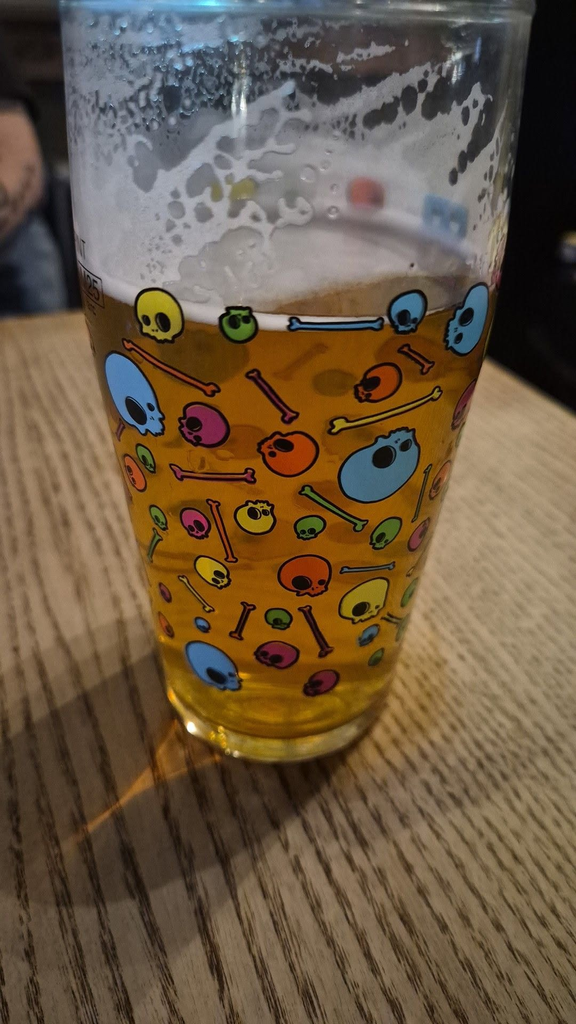
This beer was sorely needed!
There’s something about hospitals that lends them to being exhausting. On the day of her iodine treatment, my daughter had to be at the hospital for 9 am, and thus my alarm was set for 7 am. With car alarms, emergency vehicles and possibly a rubbish truck all creating a lot of noise overnight, sleep was at a premium. Once at the hospital, there was a lot of waiting around, punctured by moments of activity, such as blood tests, blood pressure tests, and other tests that meant my daughter was once again poked and prodded. Once again, she weathered all this with bravery.
The actual treatment was in pill form, and it was all over very quickly. The possibility existed of being released home the very following day, following a scan and checks on radiation levels. What a blessing that would be, if it proved true. Fortunately, it did, with a few conditions about keeping distance and being safe around the vulnerable.
All of this has left me feeling quite emotional. The other night, as I sat in the accommodation, I cried a bit, as I weighed up how close we (hopefully) are to ending this dreadful saga. I want my daughter to be healthy. I want normality to return. I don’t want us to be metaphorically looking over our shoulders, wondering what might happen next.
And Then There Were Two
Of the original Star Trek cast, only two now remain, George Takei and William Shatner. Sadly, Walter Koenig, who portrayed Pavel Chekov, has passed away at the age of 90.
It’s scary and sad to think that these people, who provided so much entertainment and inspiration to so many, are moving beyond this mortal coil. They were icons to me, and still are. My wife was fortunate enough to have a photo with both Koenig and Takei; I have had a photo with Takei and Shatner, and I am grateful to have taken that opportunity when it arose. Farewell Walter.
Manifestations of Mayhem
The first dream back in my own bed was definitely channeling the events of the previous few days. I was in a hospital as weird zombie shit unfolded, and at one point I was jumping down the stairs to bypass floors more quickly. Once outside, there was some of shootout outside the hospital, and explosions, as several assassins confronted each other. Make of that what you will.
We’d have to wait for the scan results, and I was keeping everything crossed for the best possible outcome. What I really wanted was to ‘ring the bell’ so to speak, to conclude this anxious, terrifying saga.
A Slow Return to Normal
I even managed to do a doodle!
As the dust settled on a frantic week, the last few days were spent in relative relaxation. I think as a family we had certainly earned it! Such was my weariness that on Thursday I slept in till 9:45 am! I know right, positively late… indeed, by my usual standards that’s definitely late!
Challenges certainly remain. My book efforts have completely stalled. I am certain work will contain frustration upon my return, because it always does. There is Christmas to prepare for, which is guaranteed to be stressful. My left shoulder keeps giving me grief. Still, despite all of that, drawing a line under everything to do with my daughter has taken a lot of anxiety off my plate.
Dreams have continued to be unusual, but that’s my brain’s way of processing recent events. I had a dream where my wife, daughter and I travelled to the south west, and we were staying at a small, rustic country pub. At one stage we headed into the local town, accidentally ended up in a local hospital, and we were then trying to book a doctor’s appointment. That same night also delivered a dream where I was at school, and someone threatened me, until they realised I was someone else.
The Measure of a Man
No sooner had the world of Star Trek lost Walter Koenig, it suffered another blow. One of the defining characters of The Next Generation, and indeed the entire franchise, is Jean-Luc Picard. Outwardly quite stern (at least to begin with) and disciplined, Picard proved to be a man of principle, conviction, and compassion. Never rash, always prepared to fight for his crew, and for the ideals of the Federation, Picard was inspirational.
The actor who portrayed him across seven years of The Next Generation, three seasons of Picard, and four movies, Sir Patrick Stewart, embodied many powerful ideals of his own. He campaigned for women’s rights and against domestic violence. He campaigned for better care for veterans of combat. He fought for a better understanding of pit bulls. He worked tirelessly for equality. Sir Patrick Stewart and Jean-Luc Picard were not the same person, but they certainly overlapped.
I’ve referenced before how The Next Generation was my gateway into sci-fi. The character of Picard and Sir Patrick’s performances as him are a big part of why I fell in love with Star Trek, and therefore sci-fi. To learn of his passing was to receive a body blow. I am reeling from this.
Back to the Grind
Returning to work on Saturday was not exactly a culture shock, but for some reason I had been locked out of my account, and couldn’t do anything about that until Monday. With appointments and such likely to resume at a fairly regular pace, I had to get back up to speed quickly. I can’t say I was in the mood for such things.
I certainly wasn’t in the mood for the early starts. Monday would herald the resumption of 6 am alarms and lots of scurrying around to get out of the door in a timely manner. Noone in our house was relishing that.
On the other hand, it represented a return to normal. Stability has been hard to come by in recent weeks. Routine and regular service would at least offer some form of peace.
Giving the Gift of Hope
In the wake of recent events, I want to give something back. You might have noticed this Gofundme info on the homepage, and I’m sharing it here too. The starting goal is £500, but the more that can be raised, the better.
Bitty Days and Endless Chatter
Monday was certainly a bit of a shock to the system, and what made it annoying was a steady stream of nattering customers, and endless phone calls. It was not a bad day as such, just bitty and broken up, which is annoying.
Monday also rammed home another depressing detail: the nights are now drawing in. It had not even reached 5.30 pm and it was dark outside. A bleak prospect, to put it mildly. Summer might have been overwhelmingly hot, but it was bright. I prefer summer to winter, any day.
I also prefer customers who respect opening hours. On Monday we yet again had to deal with customers who don’t respect our opening hours. It is enormously frustrating. The store is open for long hours. We are here for long hours. We are not slaves to work, and we have lives outside of the showroom. I wish people would respect this considerably more.
Tuesday had the potential to be a long day too. The sale changed, which meant point of sale needed updating. This isn’t usually as bad as it seems.
Turning Back the Clock
Eagle-eyed purveyors of Meerkat Musings might have noticed some additional Muse entries, backdated to 2020. I am in the process of slowly adding older Muses to the diary, via the Wayback Machine. It may take me a while, but I’ll get there. It’s an exercise in completeness, covering off a fairly significant portion of time, so I think it’s worthwhile.
It is here that I bring this particular Meerkat Muse to its end. Until next time!
Following on from an intriguing conversation at work, and my own curiosity, I thought I’d dig into the realm of quantum computing, and what it might mean for the future, not merely of computers, but our general lives.
What is Quantum Computing?
I am not going to even remotely pretend to understand the science and details here. To offer a simplified answer, a standard computer operates on a binary system of 1s and 0s. These 1s and 0s are regarded as standard digital bits. A quantum computer uses qubits, and what makes a qubit unique is that it can exist as a 1 and a 0, as opposed to one or the other. In fact, it can exist as both at the same time.
Qubits are linked. Changing one can change, instantly, another, even over great distances. As such, tremendous upscaling of processing power becomes possible.
What are the Challenges?
Qubits are extremely sensitive to disruption. Small vibrations, temperature changes, stray radiation… it can all break a qubit. Presently, quantum processors must be kept at extremely cold temperatures, near absolute zero, in large cryogenic freezers. These challenges are gradually being overcome, but it’s not a quick process.
What can Quantum Computing do?
Once it is established as a form of technology, quantum computing will revolutionise logistical and medical fields, with huge increases in our understanding of chemistry, materials and medicines. Since quantum computers will be able to slice through conventional encryption like a knife through warm butter, new standards of encryption would be needed, owing to the incredible mathematical power of these new machines.
What are the Potential Problems?
Well, this is where we stray into the realm of thoughts, rather than facts. Quantum computing is being augmented by, and will augment, AI. As developers strive to overcome bottlenecks in the development of quantum computing, they are turning to AI to evaluate the problems and help find solutions. Once the technology truly takes off (predicted to be between 2035 and 2040, if the field advances at its current rate), AI will be embedded in the process, and in the outcome.
Given that quantum computers will be considerably more powerful than classic computers, what might this mean for AI models? Well, it’s all way above my brain power, but with so much more computing power, and the means to perform an exponentially greater number of calculations. The extent of this on AI, and AI’s influence on it, might look something like a self-perpetuating cycle of advancement. Some theories suggest AI could rewrite its own code, far more quickly than a human code.
Now, some in the field of AI believe there’s the possibility of AI developing sentience. Some argue it already has. It’s certainly displayed some rogue characteristics, on several occasions. It gets more powerful with every passing day. What therefore happens if the incredible power of quantum computing is merged with it?
This throws up all sorts of questions about what precisely is sentience, and whether computers can achieve it. Considering that even AI company bosses think there’s a non-zero chance of AI causing humanity’s extinction within a few years, might that chance be boosted by tangling AI up in something that will enormously enhance its power?
We live in a world where the development of science has led us to some remarkable conclusions and discoveries. Some of these are disputed, some of them certainly can be disputed, and some… well, some really shouldn’t be, because they are obvious, and have been obvious for centuries.
The flat earth phenomenon is all about taking the most wild, outlandish notions, and spinning them together in a conspiracy theory that collapses under the slightest scrutiny. Unfortunately, conspiracy theorists are rarely deterred by a lack of evidence and logic, and tend to dig deeper, decrying anything that doesn’t confirm their bias.
Years ago, I got into a debate on this subject, and unsurprisingly, it went nowhere. My chief opponents ignored evidence, and make liberal use of the Alternative Syllogism Fallacy. This fallacy takes two competing ideas – A and B – and assumes that if A cannot perfectly address the available evidence, B automatically wins. It doesn’t matter if theory B is actually worse, at least, not in the eyes of its proponents. Their simplistic (or perhaps nonexistent) logic insists that all they need to do is show theory A is not perfect for their argument to win.
What makes this even worse is that there is a huge wealth of evidence to support Earth being a globe. It’s not like theory A is actually incomplete or flawed! From earliest observations of the Sun, other planets, the principles of gravity, and so much more, we have as a species collected enough proof that the Earth is not flat. Flat earthers have yet to define various mechanisms to any satisfactory degree (such as what keeps us rooted to the surface of our world if gravity is taken out of the mix), so if we followed flat earther ‘logic’ to its logical conclusion, and turned the Alternative Syllogism Fallacy against them, theory B automatically loses, by virtue of not explaining everything perfectly.
There’s a quote that brilliantly sums it all up:
Flat-Earthers seem to have a very low standard of evidence for what they want to believe but an impossibly high standard of evidence for what they don’t want to believe. Lee McIntyre, Boston University
Very soon now, American voters will shape Congress and the Senate, with choices that will greatly shape the second half of Trump’s second term as president. His MAGA worshippers are already swallowing – without any critical thinking – his lines and lies that Democrats will win via fraud and theft (much like how Trump whinged when he lost the 2020 elections). His worshippers are also in denial about the various polls, and vainly trying to suggest that they are somehow unfair on Trump.
The notion that Trump and his government might be at fault? His worshippers cannot even fathom that scenario.
Then again, why would they? They are convinced that Democrats and Democrat policies are the tools of Satan. The conservative Christian hardliners who have endorsed Trump, despite his various personal and professioanl failings, have been hoodwinked so thoroughly that they take anything he says as gospel. They believe him when he claims Democrats are turning schools into places of gender reassignment surgery, despite how absurd that concept is. They believe him when he claims voter fraud is massive, even though all the evidence suggests the exact opposite.
They don’t question Trump or his Republican sheep, believing that somehow it’s the Democrats who will stamp out freedom of expression, even as Trump’s government endorses banning books and clamps down on the media, as well as on student protests.
Part of the crisis can be linked to Trump’s ill-fated military misadventures in Iran. At one stage, there was an agreement with Iran, enforced by observers and diplomacy, to limit its nuclear program. Trump tore up that treaty, and then, a few years later, at the behest of Israel, launched attacks on the regime.
I am no lover of the Iranian regime, but raise your hand if you think attacking it was a smart move. If anything, they will be more resolved to pursue a nuclear agenda; in their view, they face hostile countries who might attack them on a whim, and you can bet internal attitudes toward America will be as bleak and angry as ever. All Trump has done is cost lives, and a huge sum of money, and damaged international trade in the process. Nothing good has come from Trump’s war, for anybody.
What’s also not gone well for Trump is his steady praise and appeasement of Russian dictator Putin. From members of his government referring to Putin as a ‘humanitarian’to Trump relaxing sanctions on Russia, Trump has rendered himself appearing weak and ineffectual on the world stage, especially when confronted with diabolical dictators. He would prefer instead to rattle his sabre at allies, and all to achieve a deal that was in place anyway. It’s painfully clear Trump is acting in his interests, not those of America, but still his worshippers refuse to see it.
Indeed, some of my usual sparring partners have been curiously silent on his treatment of Ukraine and Russia, as though pretending not to see it. I am most curious to understand why they have been quiet on this matter.
Ultimately, I am curious as to why anyone of conscience would vote for Trump, or his party, at this point. I hope my American friends vote Democrat in the midterms, and send him a clear message.
After leaving Real Madrid with mixed feelings, I took charge of the Spanish national side, who by this point (2032) had fallen pretty far from their peak of 2010 (in the game). A major point for me was to promote to the national team Antonio José Roa, a name that would ultimately come to hold a lot of in-game meaning. I’d brought him through the ranks of the Real Madrid youth system into the first team there and he’d excelled, so it seemed only right to bring him up to the top level. My tenure with Spain was short, but sweet – some good results in European Championship qualifying and some brave performances in friendlies gave me a sense of pride. However, I was about to be asked a question, one filled with temptation and danger…
There’s an old saying, ‘never go back’. Generally speaking, we move forward in life. Returning to old pastures, even if they hold happy memories, can be risky. What if you erase all that goodwill? In football this runs very true – Jose Mourinho discovered this when his second spell at Chelsea turned sour. Kevin Keegan experienced the same thing with Newcastle United. So, when Liverpool approached me with a view to returning, to have a second spell as their manager, what would I do? In the end, I was unable to resist the siren call of the club I love, so I agreed terms and headed back, though not to Anfield, as by this point Liverpool had been firmed settled into the Dalglish Arena. This was a much bigger stadium than Anfield and allowed Liverpool more clout through greater income. However, Liverpool, since my original exit in the summer of 2018, had not been as successful in some aspects, as I had expected. The Reds had won three more league titles in the fifteen year gap, though they had won five Champion’s League titles, which represented a fantastic record in such a prestigious competition.
So, how would I manage?
2033/34
I moved immediately to sign Antonio José Roa, as I was all too aware of his potential and his ability to play in the centre of the pitch, but also on either flank. He was a must buy. From there, I more or less kept faith in the team I’d inherited, which featured one of my final signings prior to leaving in 2018 – Patrick McKay, who had gone on to become a club legend in the meantime. Another Reds veteran was Yakubu Cole, who, despite getting toward the end of his career, still scored 22 goals in 37 appearances for me. McKay featured mostly as a substitute but 11 goals in 29 appearances, largely from the bench, is a good return. My star man though, was Yanis Messaoudi. 51 goals in 35 games proved massively important as my return to Liverpool was a resounding success. The Premier League title wa mine, as was the Champion’s League. It was the perfect return!
Roa meanwhile, in 34 games scored 11 goals and averaged 7.67 out of ten per game – which is, in FM terms, very impressive. He wasn’t the top performer but he was close – only Messaoudi and my strong defensive midfielder Luis Sosa, were better.
2034/35
I’d reshaped the team over the summer, with some players that I would go on to be very proud of. I poached another of my former Real Madrid players, Javi Ruiz, who could play up front or on the left. I signed lethal English striker Ellis Piper and yet another Spaniard, by the name of Ezequiel. From my youth team came defender George Westwood and ‘keeper Daniel Critchley. Messaoudi was again my top scorer, with an amazing 69 goals in 51 games, which powered my team to a second consecutive league title and a second consecutive Champion’s League title. This was also the year in which my team completed the Treble, enjoying FA Cup success as well.
2035/36
The success and goals kept coming this season as well, but the scoring duties were more shared. Messaoudi continued to bang in the goals, with 49 in 45 games, but Ezequiel scored 29 in 40 and Piper hit 55 in 49 appearances. A new rising star via my youth team, Mathew Holt, would score 16 times in 34 games as well. As a result, by the conclusion of this season, my Liverpool side had written themselves into legend, with three consecutive Premier League and Champion’s League trophies. My return to the club, filled with the potential for so much to go wrong, had been an emphatic success, with more still to come.
2036/37
What can I say? I’d been lucky to end up at a club that had the resources to mount sustained title challenges year after year. It wasn’t simply the fact that a fourth Premier League title and a fourth Champion’s League title awaited, nor a second Treble in three seasons. It was the manner in which this Liverpool side won as well. Each title was won at a canter, with the narrowest margin being six points. Each season saw plenty of goals scored and this potent attack was married to a tight defence. I was beginning to wonder at this point just how far I could keep this run going.
2037/38
Title number five was a formality, Champion’s League title five meant my Liverpool side had equalled Real Madrid’s record of five consecutive European Cups. This season also saw my team win the League Cup, thus completing another Treble of sorts. I had some more young English players appearing, Eddie Towler and Alan Hazelden in midfield, Josh Clapham at right back. Messaoudi continued to be a prolific goal scoring machine and everyone kept playing magnificently. The push was on to make history.
2038/39
Piper, Messaoudi, Ezequiel and Holt were all on top form in the league, as title six was wrapped up with ease. However, there would come a point that made me decide, enough was enough, which was to come so close to an amazing goal, yet fall right at the end.
My team had reached a sixth consecutive Champion’s League final. I had beaten some good sides in the previous finals, including Manchester United and Arsenal, but this time around, I was facing Italian side Fiorentina. They had been one of the sides to beat my Real Madrid team in one of their ill-fated finals, so I wanted a little bit of revenge. Alas, it would prove to be a step just beyond the capabilities of what was nonetheless an incredibly successful side. A 3-2, extra-time defeat left me deciding it was time to retire. What else could I achieve?
The decision to quit – metaphorically and literally as far as the game was concerned, was in hindsight a bit rash. Had I carried on more silverware would have almost certainly befell my Liverpool side, but had I been a real manager I’d be reflecting upon a tremendous (and for an English club, unprecedented) run of domestic and European titles, a, run that would echo in the annals of history and cement my squad as one of the all-time greats. To retire at that point, in my late fifties, would hardly be dishonorable.
So there you have it. The saga of my best, most satisfying Football Manager career is complete.
Nothing kinky here, unless you regard comfortable La Liga titles to be sexy. Having completed a triumphant turnaround in my first season at Real Madrid, I set about strengthening my squad with a view to winning the Champion’s League, aiming for the prize that Real Madrid covet the most. My second season in charge was about to get underway…
2028/29
In the league my team was virtually unstoppable. 38 games played, 34 wins, two draws and only two defeats meant I’d finished on 104 points, 13 points clear of Barcelona. No one could hold a candle to my side, by now virtually all regens, but within the game I had a number of stars. Italian forward Devis Ambrosi scored 66 goals in 43 games across all competitions, though he had help from Spaniard Javi Ruiz, who scored 41 goals in 47 appearances. 2029 would also see my Real Madrid side avenge their defeat to Liverpool in the previous season’s Champion’s League final, beating Arsenal to take the crown of Europe’s top team. I was pretty pleased with how the season had gone, though a manager never rests on their laurels. Two consecutive titles and a Champion’s League trophy were good, but I wanted more. Would I achieve it though?
In La Liga, the answer was an an emphatic yes. Three more seasons of title success followed, with 2029/30, 30/31 and 31/32 proving to be a continuation of the dominance I’d enjoyed in 28/29. However, I would lose the 2030 and 2032 Champion’s League finals (and my side never reached the 2031 final), which annoyed me. For a team like Real Madrid European glory is very special and very important, yet out of four finals in five seasons, I’d only managed to win it once. I felt as though I’d taken this talented team as far as I could, besides, I had another come in. One I simply could not refuse… after one small trip.
Last time out, I’d referred to feeling burnt out. I’d played a lot of Football Manager by this point and, as with all things, there can reach a saturation point – I had done well with Liverpool, pretty well with England, but with AC Milan… eh, I felt as though I’d hit a wall. However I wasn’t ready to call time on my managerial career, so I kept the file running, moving it forward every so often, waiting for that spark to reignite my interest. It would happen via the most unlikely of sources – League Two and Chesterfield.
The 2026/27 Season
I don’t recall exactly when I began my adventure in League Two, but I do remember that Chesterfield were in a little bit of trouble, flirting with relegation and certainly not looking like a side that could be promoted. I had my work cut out for me – there was no big budget, I had to use what I had and use it wisely if I were to avoid relegation and aim any higher. I began to turn results around, sticking to the tactics that had yielded me so much success in the past. It pleased me to see the team respond and to climb the table – as they did, they appeared to be inching closer to the playoff places, which had seemed unlikely earlier in the season. A strong run of results (with a couple of defeats thrown in, just to make me nervous) saw Chesterfield squeak into the playoffs, whereupon they would dramatically impress me by going on to actually win the playoffs, earning promotion to League One for the following season.
27/28
I’m quite proud of this next season, for a couple of reasons. The first half of it saw my Chesterfield side at one stage go on a thirteen game unbeaten run to put them firmly in the race for promotion yet again. It was a tall order to expect two consecutive promotions but the team was playing well and getting results, making it a possibility – only it would not be one I would end up seeing out. I had a call (metaphorically of course – this is a game) from a club I just couldn’t turn down – one of the world’s most famous names, a club steeped in history – Real Madrid. They had dismissed Laurent Blanc (who had led them to mid-table mediocrity) in November, approaching me to replace him. It was in the end, if I am being completely honest with myself, an easy decision – not completely without regret, for my brief time at Chesterfield had restored my enjoyment of the game – to become Real’s new boss.
That big run of green results (wins)? Yeah, that was me. Not to brag, but I managed to turn Real around from a side that looked off their game, into one that ruthlessly hunted down La Liga’s leaders Barcelona. I enjoyed a fantastic 4-1 away win against them, which set me up nicely and seemed to knock them off balance. From at one stage looking like Real would not even qualify for the Champion’s League (unthinkable for a club like Real), to winning the title with games to spare, was an epic feeling. I don’t think I’d ever felt more satisfied with a title win than at that moment – but, there was still more football to come, with a Champion’s League final against a familiar foe – Liverpool.
The last time I’d met Liverpool in a Champion’s League final they had handed me my ass. 8-0 in any cup final is virtually unprecedented, least of all in the final of Europe’s premier club competition, so I was going into this with a certain measure of wanting revenge. Alas, it was not to be. A thrashing it was not, but the game finished 5-3 to Liverpool, after extra time. Still, I had done a league and cup double, humiliating Barcelona on more than occasion along the way.
Having resigned as England manager following a disappointing World Cup (I honestly cannot convey just how disappointed I was), I had a bit of a hiatus. I had left England in July 2022, and did not not take up a new post until November, when I would begin my first overseas adventure.
In case it wasn’t obvious from the title of the chapter, I was heading to Italy – to Serie A, and to AC Milan.
At the time of taking over, Milan were seven-time European champions, making them the most successful Italian club in Europe. They had been doing okay in the league but not brilliantly – hence why there was an opening.
My very first match? Well, it ended up being a whopper – away, to fierce rivals Inter Milan (well, they share the San Siro, so technically not away, but you know what I mean). I could have done without being chucked into the lion’s den but I guess there’s no better way to get to grips with a new league than to dive right into one of its most passionate derbies, and the new manager effect was working very well, with an 8-2 win for me (yes, you read that correctly).
I’d embark on a reasonable sequence of results, but would be a little surprised to exit the Europa League at the quarter-final stage (against Celtic), and the league campaign was dented by five defeats that happened before I’d even joined – three more defeats would befall my Milan side, but not in the Coppa Italia, that I would go on to win (thus maintaining my record of a trophy won in every season I’d been at a club side). I also squeaked into 2nd place in Seri A, thus ensuring Champions League football for the following season.
So who were the architects of my cup-winning first season in Italy? Stephan El Shaarawy (who right now plays for Roma) was a strong performer on the right-wing for me, whilst Pablo Albini (a regen) was pulling the strings in the centre of my midfield. My two best performers though, were Willian (on the left-wing, with an average rating of 7.72), and striker Almando Calvo (who scored 59 goals in 53 appearances).
So the 2022/23 season had ended on a reasonably positive note.
2023/24
My first full season at the San Siro would begin quite strongly. I would win my first seven league games, scoring 21 goals and conceding none. A bit of a blip followed soon thereafter, with only one win in five games slowing my progress. A sequence of eight consecutive victories put my title campaign back on track, and I would only suffer four league defeats over the course of the season to close out the title very comfortably – finishing 23 points clear of Fiorentina. 105 goals scored and 33 conceded emphasised the lethal attack of my side, and their confidence in defence.
Whilst Seri A was a resounding success (powered by 48 league goals from Armando Calvo), my Champions League fortunes would rock me to the core. I got Milan out of the group stages easily enough (despite a 7-2 away defeat to French side Marseille), and dispatched Tottenham, Roma and Barcelona en-route to the final (Roma were also my opponents in the Coppa Italia final – they beat me 4-2).
For the Champions League final, my opposition would be my old club Liverpool. It was rather poetic to face off against them on the biggest stage, but the result was devastating. Liverpool inflicted a bruising 8-0 defeat upon me, completely outplaying my Milan side in every respect. The nature of the defeat left me shaken in my confidence, reeling from what had happened. In fact it rocked me to the point where I felt my interest in the game diminish. I would start the 2024/25 season still at AC Milan, but would see out only about half the campaign before deciding – both metaphorically and literally – that I was done with Football Manager for the moment.
In the previous installment the curtain came down on my time at Liverpool, with the final record being one to be quite proud of. Three Premier League titles, three Champions League titles, three FA Cups and one League Cup came my way – not a bad return for seven seasons of work! However, going into the pre-season of the 18/19 season, I was offered a position I just couldn’t refuse (even though, if memory serves me correctly, I already had refused it once before!).
England had come knocking, following the resignation of Roberto Mancini (yes, that’s right), who had in turn replaced Stuart Pearce (who was manager when the game started in 2011). Pearce had seen England through to winning two consecutive European Championships (yes, somehow, in this game, England were winning things) before resigning, and Mancini… well, he apparently didn’t achieve much of note, resigning after the 2018 World Cup. I took charge at the end of July 2018, keen to see what progress I could make.
There were a number of players in the squad who might be familiar to you now. James Milner was still involved in the team, as was Wayne Rooney, along with the likes of Ryan Shawcross, Joe Hart, Jack Wilshere, Ross Barkley, and several other names that might actually end up appearing in the 2018 World Cup and beyond – we shall have to see if life imitates fiction. I would go about making tactical changes and would look to pick players based upon merit, rather than reputation, though the talent pool available to me would sometimes restrict my options.
Rooney and Patrick McKay (I told you to remember that name) would be the main strike force of choice, with McKay going on to have a very impressive start to his England career. In 2018 he would score 9 goals in 13 appearances, whilst in 2019 his record was even better, with 17 goals from 10 games. Believe it or not, Tom Cleverley would not play too badly for me, Jack Robinson was very impressive at left-back and Alex Oxlade-Chamberlain would put in some cracking performances on the right-wing. My England team would qualify for the Euros by winning seven out of eight games, drawing the other fixture, to top the group quite comfortably.
So, it was on to the 2020 European Championships, hosted by Belgium. Drawn in a group featuring Denmark, Holland and Wales, I would actually lose one of the games (I can’t recall which), but I would finish second in the group to be assured of automatic qualification to round 2. Awaiting me were the Spaniards, and I won quite easily, 3-0.
A tight affair followed against Italy, where my England team ran out 1-0 winners, and I followed this up with a 6-0 semi-final victory over Greece – the final would be against France, and this would end up being a 3-0 win for me.
So, in the knockout rounds alone, my team scored 13 goals in 4 games. Overall, they managed 23 goals in 7 games, conceding 5. England had won three consecutive European Championships – quite the achievement!
With one half of the major international trophy collection won, my attention turned to the World Cup – the star prize, and the one outstanding prize left to be won on the game (unless we count the Europa League, and frankly, I don’t). Qualification went well enough, with 10 out of 10 games won, 47 goals scored and only 3 conceded. McKay remained a major scorer of goals – 18 in 13 matches in 2021 – whilst another newbie, Dimos Chailis, contributed 7 goals in 7 games. I was pretty pleased with some of the youngsters coming through the ranks – William Cox in defence, Martyn Bell in goal, Alex Eyre up front, and Trayon Holligan in midfield, and Robbie Barry (an attacking player, but I can’t remember where) were all pushing the established stars, and the performances of the side in the build up to the 2022 World Cup were encouraging.
My very first World Cup game was against the USA, and a 4-3 defeat was not what I had expected, but a 2-0 win over Mali and a 4-0 win over Czech Republic saw me into the knockout rounds, and I would beat Germany 2-1 to set up a quarter-final meeting with Argentina.
It was here that my hopes and dreams were dashed, in that most England of ways – a penalty shootout. Shortly afterward I resigned as England manager, disenchanted with the international scene (at least, for the moment). Some of the players I had brought into the squad would remain there, and two more European Championships would come England’s way (as part of a remarkable sequence of five in a row) – but would there be a World Cup? You’ll have to keep reading if you want to find out.
We use cookies to ensure that we give you the best experience on our website. If you continue to use this site we will assume that you are happy with it.
You can revoke your consent any time using the revoke consent button.