leg holding soccer ball

After leaving Real Madrid with mixed feelings, I took charge of the Spanish national side, who by this point (2032) had fallen pretty far from their peak of 2010 (in the game). A major point for me was to promote to the national team Antonio José Roa, a name that would ultimately come to hold a lot of in-game meaning. I’d brought him through the ranks of the Real Madrid youth system into the first team there and he’d excelled, so it seemed only right to bring him up to the top level. My tenure with Spain was short, but sweet – some good results in European Championship qualifying and some brave performances in friendlies gave me a sense of pride. However, I was about to be asked a question, one filled with temptation and danger…

There’s an old saying, ‘never go back’. Generally speaking, we move forward in life. Returning to old pastures, even if they hold happy memories, can be risky. What if you erase all that goodwill? In football this runs very true – Jose Mourinho discovered this when his second spell at Chelsea turned sour. Kevin Keegan experienced the same thing with Newcastle United. So, when Liverpool approached me with a view to returning, to have a second spell as their manager, what would I do? In the end, I was unable to resist the siren call of the club I love, so I agreed terms and headed back, though not to Anfield, as by this point Liverpool had been firmed settled into the Dalglish Arena. This was a much bigger stadium than Anfield and allowed Liverpool more clout through greater income. However, Liverpool, since my original exit in the summer of 2018, had not been as successful in some aspects, as I had expected. The Reds had won three more league titles in the fifteen year gap, though they had won five Champion’s League titles, which represented a fantastic record in such a prestigious competition.

So, how would I manage?


2033/34

I moved immediately to sign Antonio José Roa, as I was all too aware of his potential and his ability to play in the centre of the pitch, but also on either flank. He was a must buy. From there, I more or less kept faith in the team I’d inherited, which featured one of my final signings prior to leaving in 2018 – Patrick McKay, who had gone on to become a club legend in the meantime. Another Reds veteran was Yakubu Cole, who, despite getting toward the end of his career, still scored 22 goals in 37 appearances for me. McKay featured mostly as a substitute but 11 goals in 29 appearances, largely from the bench, is a good return. My star man though, was Yanis Messaoudi. 51 goals in 35 games proved massively important as my return to Liverpool was a resounding success. The Premier League title wa mine, as was the Champion’s League. It was the perfect return!

Roa meanwhile, in 34 games scored 11 goals and averaged 7.67 out of ten per game – which is, in FM terms, very impressive. He wasn’t the top performer but he was close – only Messaoudi and my strong defensive midfielder Luis Sosa, were better.


2034/35

I’d reshaped the team over the summer, with some players that I would go on to be very proud of. I poached another of my former Real Madrid players, Javi Ruiz, who could play up front or on the left. I signed lethal English striker Ellis Piper and yet another Spaniard, by the name of Ezequiel. From my youth team came defender George Westwood and ‘keeper Daniel Critchley. Messaoudi was again my top scorer, with an amazing 69 goals in 51 games, which powered my team to a second consecutive league title and a second consecutive Champion’s League title. This was also the year in which my team completed the Treble, enjoying FA Cup success as well.


2035/36

The success and goals kept coming this season as well, but the scoring duties were more shared. Messaoudi continued to bang in the goals, with 49 in 45 games, but Ezequiel scored 29 in 40 and Piper hit 55 in 49 appearances. A new rising star via my youth team, Mathew Holt, would score 16 times in 34 games as well. As a result, by the conclusion of this season, my Liverpool side had written themselves into legend, with three consecutive Premier League and Champion’s League trophies. My return to the club, filled with the potential for so much to go wrong, had been an emphatic success, with more still to come.


2036/37

What can I say? I’d been lucky to end up at a club that had the resources to mount sustained title challenges year after year. It wasn’t simply the fact that a fourth Premier League title and a fourth Champion’s League title awaited, nor a second Treble in three seasons. It was the manner in which this Liverpool side won as well. Each title was won at a canter, with the narrowest margin being six points. Each season saw plenty of goals scored and this potent attack was married to a tight defence. I was beginning to wonder at this point just how far I could keep this run going.


2037/38

Title number five was a formality, Champion’s League title five meant my Liverpool side had equalled Real Madrid’s record of five consecutive European Cups. This season also saw my team win the League Cup, thus completing another Treble of sorts. I had some more young English players appearing, Eddie Towler and Alan Hazelden in midfield, Josh Clapham at right back. Messaoudi continued to be a prolific goal scoring machine and everyone kept playing magnificently. The push was on to make history.


2038/39

Piper, Messaoudi, Ezequiel and Holt were all on top form in the league, as title six was wrapped up with ease. However, there would come a point that made me decide, enough was enough, which was to come so close to an amazing goal, yet fall right at the end.

My team had reached a sixth consecutive Champion’s League final. I had beaten some good sides in the previous finals, including Manchester United and Arsenal, but this time around, I was facing Italian side Fiorentina. They had been one of the sides to beat my Real Madrid team in one of their ill-fated finals, so I wanted a little bit of revenge. Alas, it would prove to be a step just beyond the capabilities of what was nonetheless an incredibly successful side. A 3-2, extra-time defeat left me deciding it was time to retire. What else could I achieve?

The decision to quit – metaphorically and literally as far as the game was concerned, was in hindsight a bit rash. Had I carried on more silverware would have almost certainly befell my Liverpool side, but had I been a real manager I’d be reflecting upon a tremendous (and for an English club, unprecedented) run of domestic and European titles, a, run that would echo in the annals of history and cement my squad as one of the all-time greats. To retire at that point, in my late fifties, would hardly be dishonorable.

So there you have it. The saga of my best, most satisfying Football Manager career is complete.

Back to Football Manager

leg holding soccer ball

Nothing kinky here, unless you regard comfortable La Liga titles to be sexy. Having completed a triumphant turnaround in my first season at Real Madrid, I set about strengthening my squad with a view to winning the Champion’s League, aiming for the prize that Real Madrid covet the most. My second season in charge was about to get underway…

2028/29

In the league my team was virtually unstoppable. 38 games played, 34 wins, two draws and only two defeats meant I’d finished on 104 points, 13 points clear of Barcelona. No one could hold a candle to my side, by now virtually all regens, but within the game I had a number of stars. Italian forward Devis Ambrosi scored 66 goals in 43 games across all competitions, though he had help from Spaniard Javi Ruiz, who scored 41 goals in 47 appearances. 2029 would also see my Real Madrid side avenge their defeat to Liverpool in the previous season’s Champion’s League final, beating Arsenal to take the crown of Europe’s top team. I was pretty pleased with how the season had gone, though a manager never rests on their laurels. Two consecutive titles and a Champion’s League trophy were good, but I wanted more. Would I achieve it though?

In La Liga, the answer was an an emphatic yes. Three more seasons of title success followed, with 2029/30, 30/31 and 31/32 proving to be a continuation of the dominance I’d enjoyed in 28/29. However, I would lose the 2030 and 2032 Champion’s League finals (and my side never reached the 2031 final), which annoyed me. For a team like Real Madrid European glory is very special and very important, yet out of four finals in five seasons, I’d only managed to win it once. I felt as though I’d taken this talented team as far as I could, besides, I had another come in. One I simply could not refuse… after one small trip.

On to Part Eight

Back to Football Manager

leg holding soccer ball

Last time out, I’d referred to feeling burnt out. I’d played a lot of Football Manager by this point and, as with all things, there can reach a saturation point – I had done well with Liverpool, pretty well with England, but with AC Milan… eh, I felt as though I’d hit a wall. However I wasn’t ready to call time on my managerial career, so I kept the file running, moving it forward every so often, waiting for that spark to reignite my interest. It would happen via the most unlikely of sources – League Two and Chesterfield.

The 2026/27 Season

I don’t recall exactly when I began my adventure in League Two, but I do remember that Chesterfield were in a little bit of trouble, flirting with relegation and certainly not looking like a side that could be promoted. I had my work cut out for me – there was no big budget, I had to use what I had and use it wisely if I were to avoid relegation and aim any higher. I began to turn results around, sticking to the tactics that had yielded me so much success in the past. It pleased me to see the team respond and to climb the table – as they did, they appeared to be inching closer to the playoff places, which had seemed unlikely earlier in the season. A strong run of results (with a couple of defeats thrown in, just to make me nervous) saw Chesterfield squeak into the playoffs, whereupon they would dramatically impress me by going on to actually win the playoffs, earning promotion to League One for the following season.

27/28

I’m quite proud of this next season, for a couple of reasons. The first half of it saw my Chesterfield side at one stage go on a thirteen game unbeaten run to put them firmly in the race for promotion yet again. It was a tall order to expect two consecutive promotions but the team was playing well and getting results, making it a possibility – only it would not be one I would end up seeing out. I had a call (metaphorically of course – this is a game) from a club I just couldn’t turn down – one of the world’s most famous names, a club steeped in history – Real Madrid. They had dismissed Laurent Blanc (who had led them to mid-table mediocrity) in November, approaching me to replace him. It was in the end, if I am being completely honest with myself, an easy decision – not completely without regret, for my brief time at Chesterfield had restored my enjoyment of the game – to become Real’s new boss.

That big run of green results (wins)? Yeah, that was me. Not to brag, but I managed to turn Real around from a side that looked off their game, into one that ruthlessly hunted down La Liga’s leaders Barcelona. I enjoyed a fantastic 4-1 away win against them, which set me up nicely and seemed to knock them off balance. From at one stage looking like Real would not even qualify for the Champion’s League (unthinkable for a club like Real), to winning the title with games to spare, was an epic feeling. I don’t think I’d ever felt more satisfied with a title win than at that moment – but, there was still more football to come, with a Champion’s League final against a familiar foe – Liverpool.

The last time I’d met Liverpool in a Champion’s League final they had handed me my ass. 8-0 in any cup final is virtually unprecedented, least of all in the final of Europe’s premier club competition, so I was going into this with a certain measure of wanting revenge. Alas, it was not to be. A thrashing it was not, but the game finished 5-3 to Liverpool, after extra time. Still, I had done a league and cup double, humiliating Barcelona on more than occasion along the way.

On to Part Seven

Back to Football Manager

leg holding soccer ball

Having resigned as England manager following a disappointing World Cup (I honestly cannot convey just how disappointed I was), I had a bit of a hiatus. I had left England in July 2022, and did not not take up a new post until November, when I would begin my first overseas adventure.

In case it wasn’t obvious from the title of the chapter, I was heading to Italy – to Serie A, and to AC Milan.

At the time of taking over, Milan were seven-time European champions, making them the most successful Italian club in Europe. They had been doing okay in the league but not brilliantly – hence why there was an opening.

My very first match? Well, it ended up being a whopper – away, to fierce rivals Inter Milan (well, they share the San Siro, so technically not away, but you know what I mean). I could have done without being chucked into the lion’s den but I guess there’s no better way to get to grips with a new league than to dive right into one of its most passionate derbies, and the new manager effect was working very well, with an 8-2 win for me (yes, you read that correctly).

I’d embark on a reasonable sequence of results, but would be a little surprised to exit the Europa League at the quarter-final stage (against Celtic), and the league campaign was dented by five defeats that happened before I’d even joined – three more defeats would befall my Milan side, but not in the Coppa Italia, that I would go on to win (thus maintaining my record of a trophy won in every season I’d been at a club side). I also squeaked into 2nd place in Seri A, thus ensuring Champions League football for the following season.

So who were the architects of my cup-winning first season in Italy? Stephan El Shaarawy (who right now plays for Roma) was a strong performer on the right-wing for me, whilst Pablo Albini (a regen) was pulling the strings in the centre of my midfield. My two best performers though, were Willian (on the left-wing, with an average rating of 7.72), and striker Almando Calvo (who scored 59 goals in 53 appearances).

So the 2022/23 season had ended on a reasonably positive note.

2023/24

My first full season at the San Siro would begin quite strongly. I would win my first seven league games, scoring 21 goals and conceding none. A bit of a blip followed soon thereafter, with only one win in five games slowing my progress. A sequence of eight consecutive victories put my title campaign back on track, and I would only suffer four league defeats over the course of the season to close out the title very comfortably – finishing 23 points clear of Fiorentina. 105 goals scored and 33 conceded emphasised the lethal attack of my side, and their confidence in defence.

Whilst Seri A was a resounding success (powered by 48 league goals from Armando Calvo), my Champions League fortunes would rock me to the core. I got Milan out of the group stages easily enough (despite a 7-2 away defeat to French side Marseille), and dispatched Tottenham, Roma and Barcelona en-route to the final (Roma were also my opponents in the Coppa Italia final – they beat me 4-2).

For the Champions League final, my opposition would be my old club Liverpool. It was rather poetic to face off against them on the biggest stage, but the result was devastating. Liverpool inflicted a bruising 8-0 defeat upon me, completely outplaying my Milan side in every respect. The nature of the defeat left me shaken in my confidence, reeling from what had happened. In fact it rocked me to the point where I felt my interest in the game diminish. I would start the 2024/25 season still at AC Milan, but would see out only about half the campaign before deciding – both metaphorically and literally – that I was done with Football Manager for the moment.

On to Part Six

Back to Football Manager

leg holding soccer ball

In the previous installment the curtain came down on my time at Liverpool, with the final record being one to be quite proud of. Three Premier League titles, three Champions League titles, three FA Cups and one League Cup came my way – not a bad return for seven seasons of work! However, going into the pre-season of the 18/19 season, I was offered a position I just couldn’t refuse (even though, if memory serves me correctly, I already had refused it once before!).

England had come knocking, following the resignation of Roberto Mancini (yes, that’s right), who had in turn replaced Stuart Pearce (who was manager when the game started in 2011). Pearce had seen England through to winning two consecutive European Championships (yes, somehow, in this game, England were winning things) before resigning, and Mancini… well, he apparently didn’t achieve much of note, resigning after the 2018 World Cup. I took charge at the end of July 2018, keen to see what progress I could make.

There were a number of players in the squad who might be familiar to you now. James Milner was still involved in the team, as was Wayne Rooney, along with the likes of Ryan Shawcross, Joe Hart, Jack Wilshere, Ross Barkley, and several other names that might actually end up appearing in the 2018 World Cup and beyond – we shall have to see if life imitates fiction. I would go about making tactical changes and would look to pick players based upon merit, rather than reputation, though the talent pool available to me would sometimes restrict my options.

Rooney and Patrick McKay (I told you to remember that name) would be the main strike force of choice, with McKay going on to have a very impressive start to his England career. In 2018 he would score 9 goals in 13 appearances, whilst in 2019 his record was even better, with 17 goals from 10 games. Believe it or not, Tom Cleverley would not play too badly for me, Jack Robinson was very impressive at left-back and Alex Oxlade-Chamberlain would put in some cracking performances on the right-wing. My England team would qualify for the Euros by winning seven out of eight games, drawing the other fixture, to top the group quite comfortably.

So, it was on to the 2020 European Championships, hosted by Belgium. Drawn in a group featuring Denmark, Holland and Wales, I would actually lose one of the games (I can’t recall which), but I would finish second in the group to be assured of automatic qualification to round 2. Awaiting me were the Spaniards, and I won quite easily, 3-0.

A tight affair followed against Italy, where my England team ran out 1-0 winners, and I followed this up with a 6-0 semi-final victory over Greece – the final would be against France, and this would end up being a 3-0 win for me.

So, in the knockout rounds alone, my team scored 13 goals in 4 games. Overall, they managed 23 goals in 7 games, conceding 5. England had won three consecutive European Championships – quite the achievement!

With one half of the major international trophy collection won, my attention turned to the World Cup – the star prize, and the one outstanding prize left to be won on the game (unless we count the Europa League, and frankly, I don’t). Qualification went well enough, with 10 out of 10 games won, 47 goals scored and only 3 conceded. McKay remained a major scorer of goals – 18 in 13 matches in 2021 – whilst another newbie, Dimos Chailis, contributed 7 goals in 7 games. I was pretty pleased with some of the youngsters coming through the ranks – William Cox in defence, Martyn Bell in goal, Alex Eyre up front, and Trayon Holligan in midfield, and Robbie Barry (an attacking player, but I can’t remember where) were all pushing the established stars, and the performances of the side in the build up to the 2022 World Cup were encouraging.

My very first World Cup game was against the USA, and a 4-3 defeat was not what I had expected, but a 2-0 win over Mali and a 4-0 win over Czech Republic saw me into the knockout rounds, and I would beat Germany 2-1 to set up a quarter-final meeting with Argentina.

It was here that my hopes and dreams were dashed, in that most England of ways – a penalty shootout. Shortly afterward I resigned as England manager, disenchanted with the international scene (at least, for the moment). Some of the players I had brought into the squad would remain there, and two more European Championships would come England’s way (as part of a remarkable sequence of five in a row) – but would there be a World Cup? You’ll have to keep reading if you want to find out.

On to Part Five

Back to Football Manager

leg holding soccer ball

So last time out I was regaling you all with how I had just won the 2016/17 Champions League title, and narrowly missed out on the Premier League title. I’d ‘played the system’, as it were, to ensure Barcelona were managerless going into the final of the Champions League, and thus were easier to beat. It was sweet vengeance for the previous season’s defeat.

Moving into the 2017/18 season, I wanted to try and build upon the foundations I had laid.

2017/18

Once again Luis Suarez and Giuseppe Rossi were leading my attack, and the squad was largely unchanged from the previous season, but Eric Dier was starting to become more involved in the first team (and with good reason – his performances were pretty good in the centre of my defence), and I signed a Brazilian right-back by the name of Fágner, who did pretty well too. There was however, one player who would start to make waves that I had signed the previous year. A youngster by the name of Patrick McKay had joined me from Man City, and he would make 39 appearances in all over the course of the season, scoring 24 goals. Remember his name, for it will be significant later.

I wanted the Premier League title. It had been within Liverpool’s grasp yet it was narrowly denied by the margin of one goal, that my team just couldn’t find. I was therefore determined to make that right. My first two games went according to plan – a 4-0 win over West Ham and a 5-0 win over Fulham was the beginning I had wanted, but following this up with a 3-1 defeat against Man City and a 1-0 defeat to Celtic in the Champions League arrested that early momentum. My side were knocked out of the League Cup with a 3-2 home defeat to local rivals Everton – hardly ideal!

Following from that ropy start was a sequence of 13 consecutive victories in the league, and I would also win my remaining five Champions League fixtures to top the group. As the season progressed, my team was in mean form, racking up some big wins, including a 5-1 away win against Norwich, a 5-0 home win over Everton, a 5-0 win over Man City (whom I would also beat 7-1 in the FA Cup) and a 6-0 win over Burnley. A rather satisfying 5-0 win over Man Utd meant I’d quite comfortably crushed the Manchester sides at Anfield.

Thrilling draws away to Arsenal (3-3) and Chelsea (4-4), a home defeat to Newcastle and a defeat away to Sunderland did stall things a little, but more annoying was that the Sunderland defeat came at the end of a brief but miserable sequence that saw Liverpool exit the FA Cup after losing 4-3 at home to Chelsea and saw my Champions League progress placed in jeopardy with a 3-1 loss away to Spanish side Málaga. Four straight league wins followed, as did a 4-0 home win to overturn that deficit against Málaga, but the curse of my away form against Man Utd and Everton would see me lose at both sides to keep the title race interesting.

Celtic were easily dispatched in the quarter-finals of the Champions League and in the semi-final I would face PSG, who had ended my first defence of my European title in 2014. I would lose in Paris but win easily at Anfield, moving into my third straight Champions League final. Beating Spurs 6-3 at Anfield (my chief title rivals) and winning my final three games meant I had won the Premier League for the first time since 2015 – my final game of the season would be against Chelsea in the Champions League final.

I won’t sugarcoat it. I won 2-0 and had therefore defended my place as European champions (WOO!).

It was here that my Liverpool journey would end.

At this stage, I had nothing left to (metaphorically) prove. I had taken Liverpool from being on the edge of contending for majors honours to actually winning major honours, and doing so repeatedly. Needless to say, I was pretty pleased! The team had progressed nicely and had become a serious force in both the Premier League and in Europe. I felt that I couldn’t take them any further, so it was time to go.

Where did I go from here? That would be telling. You’ll find out next time.

On to Part Four

Back to Football Manager

leg holding soccer ball

Where did we leave this adventure last time out? Ah yes, Liverpool had just won the Premier League title and the Champions League. All was good and right with the universe, but things wouldn’t stay that way.

2013/14

The irony about the 2013/14 season is that in reality, this represented a ‘nearly’ year for Liverpool. They went agonisingly close to claiming their first title since 1990 – for me, that burden no longer applied, and I went into the season as reigning champions – which created a whole new kind of expectation, the desire to win back-to-back titles.

The squad was more or less the same as before (I saw no reason to make drastic changes and unhinge my side), except I brought in Marek Hamsik from Napoli, and Rodriguez was moved on (I think). Hamsik spent much of his first season rotating with Lucas in the defensive midfielder role, though he was also capable of playing out on the left and as a more central-minded midfielder. Youngsters like Harry Kane, Jack Robinson and Martin Kelly got reasonable runs in the first team, but despite the goal-scoring feats of Luis Suarez and Giuseppe Rossi, I could not guide Liverpool to a second consecutive league title. Instead, my side would finish two points behind eventual winners Manchester City.

The Champions League brought no relief. Whilst my side qualified from the group stages, the journey to retain that particular trophy ended rather ingloriously in the first knockout round, with a tame 2-1 aggregate defeat to Shakthar.

At least the 13/14 season wasn’t a completely barren one. A 3-0 win over Colo Colo brought the Reds World Club Championship success, a 3-2 win over Aston Villa brought me the League Cup, and I collected my second FA Cup with a comfortable 3-0 routing of Sunderland.

2014/15

There’s a reason the title of this chapter is called ‘Inconsistency’. Having failed to win the title the previous season, things would flip around completely in 2014/15, with my team winning the Premier League at a relative canter, nine points clear of Man City and with a goal difference of +83.

The backbone of this success was a miserly defence that conceded only 25 goals all season, and of course, the exploits up front of Suarez and Rossi, who between them scored 86 goals. I gave a first team debut to youth team players Gavin Pringle and John Allsop, and also set about putting Danny Wilson into the first team on a regular basis. Jordan Henderson continued his upward progress as a footballer, and I also achieved what I regard as one of the bargains of the century – I signed Jack Wilshere from Arsenal for £20 million. He put in a good shift (as did pretty much everyone), but the league was the only prize to be won.

My Champions League adventure ended at the quarter-final stage. I’d thumped Paris St Germain 5-2 in the first leg at Anfield, and was thus quietly confident of reaching the next round – oh how wrong I would be! A 4-0 thrashing was meted out to me in Paris – putting my European adventure to an end for another season. Disappointing FA Cup and League Cup runs also took place. Still, a second league title in four seasons as manager wasn’t too bad.

2015/16

The following season I would not only fail to defend the league title, but Liverpool would slip to third in the standings by season’s end, only one point behind second-placed Manchester United – but six points behind Premier League winners Tottenham (Leicester, in case you’re wondering, weren’t even in the top flight on the game at this stage). The season starting brightly enough – my first results were – 7-0, 8-0, 4-1, 4-1, 3-1 (Champions League), 3-1, 4-3 (an extra-time League Cup win over Man City), but a shock 3-1 defeat to West Brom followed, and this was immediately followed by a 3-1 defeat against Barcelona in the Champions League. I would go on to lose to Barcelona again in the home group stage game, but would follow them into the knockout stages.

League form included a defeat away to Chelsea, but after that the ship steadied. Eight consecutive wins followed, and the team went unbeaten for 14 matches before becoming a cropper at Stoke. In the middle of all this the team reached the League Cup Final (but would be defeated on penalties against Spurs), and I would guide Liverpool to the Champions League Final (knocking out Marseilles, Fiorentina and Paris St Germain along the way).

As the season neared its conclusion, league form began to dip. Defeats way to Everton, Arsenal and Manchester United came just when I needed the team to keep pushing and keep winning, though I would knock Man Utd out of the FA Cup at the Semi-Final stage and go on to beat Spurs in the Final, avenging my League Cup defeat, and also ensuring that my record of winning at least one trophy every season had been maintained.

For the Champions League Final, I was up against the mighty Barcelona – and whilst my memories of this occasion are fuzzy, I do remember that losing on penalties after a 2-2 draw felt like an injustice – something makes me think that the result was somewhat harsh on my side, who I felt deserved more for their efforts. Having reached three cup finals and only winning one was also a bit… disappointing, shall we say?

2016/17

I remember this campaign for two reasons. Firstly, the nail-biting end to the Premier League title race, and secondly, the Champions League Final.

The squad was more or less unchanged from the previous two seasons, except I signed Turkish attacking Midfielder Gökhan Töre from German side HSV. Jack Wilshere would miss pretty much the entire season through injury (art imitating life there), but Gökhan Töre Would provide skilled cover. Over the course of the fight to win the league, the team was slow and steady to begin with (not as free-scoring as in previous seasons), but in the Champions League, the group was pretty straightforward, with 5 wins out of 6.

In the first knockout stage, Liverpool would thump Leverkusen 4-0 away from home and go on to win 3-2 at Anfield, setting up a mouthwatering Quarter-Final against Man Utd. Having recently beaten them 3-0 in the Premiership at Anfield, that result was almost repeated in the first leg – I ran out 3-1 winners. In the second leg I held Utd to a 1-1 draw and booked a Semi-Final against Spanish giants Real Madrid.

Whilst this was going on the title race was drawing closer to a conclusion – and going into the final round of the season, with a few stuttering performances costing me, Liverpool would be away against one of the contenders, Chelsea.

What I needed was a win. There were no two ways about it – a win and the title (thanks to Man Utd drawing away with Norwich) would be mine. Matches away to Chelsea were never ones I had found to be easy, but as the game ticked by, with the score at 2-2, one more goal and my Liverpool side would be champions on the basis of far superior goal difference. Unfortunately, despite pressing, that goal just would not come, and Chelsea were champions.

I now found my hopes of maintaining my trophy-streak resting on one match – the Champions League Final, and my opponents? Once again, Barcelona.

This is where one of the most remarkable sequences of events conspired to help me out, and I don’t mind admitting that I ‘played the game’ to ensure my team had the best possible chance. Pep Guardiola had left Barcelona at the end of the previous season, and in his stead had come Rafa Benitez. Somehow, Benitez had taken Guardiola’s team of incredible talents and ushered them down La Liga to fifth, and therefore without Champions League football if they failed to win in the Final. With the La Liga season concluded, Barcelona took the decision to sack Benitez with less than a couple of weeks to go before the Final – and they approached me to replace him.

I told Barca I’d consider it, though in reality I had no intention of quitting Liverpool at that stage. Barca agreed, meaning they’d go into the Champions League Final with a caretaker manager, and I knew this would give me an edge. I was proven right, as Liverpool won 3-1, avenging last season’s cruel penalty loss and claiming European Cup no. 7.

So, see what I mean about inconsistency? Winning consecutive titles had proven elusive, but with Big Ears returning to Anfield, was this to be the catalyst for sustained success? We’ll have to wait for the next chapter in this little story…

On to Part Three

Back to Football Manager

leg holding soccer ball

A while ago I attempted to write down what I consider to be my best ever career on a Football Manager sim – one that I am quite proud of actually (insofar as one is proud of what they achieve on a computer game). My first effort to jot down my career stalled due to lack of effort on my part – so here we go again!

The game I achieved this all on is the 2012 edition of Football Manager – so we’re going back a few years, and I’ll admit my memory of it all is fuzzy. I am actually still playing through the save in question – but as a different ‘character’, so to speak, having retired the manager I plan to talk about.

FM12 starts in the summer of 2011, so the sides you take charge of are notably different to what they look like right now. Being the lunatic that I am, I chose Liverpool (naturally, since they are the team that I support) to play as.

Rewinding to 2011 means the squad is different – Steven Gerrard still had a few years left in his prime, Luis Suarez was still a Red, and the likes of Stuart Downing, Craig Bellamy, Dirk Kuyt and Peter Crouch were all still at the club. Jamie Carragher and Daniel Agger were still on the scene too, a certain Raheem Sterling was an up-and-coming starlet and there was plenty of work to do if Liverpool were to be transformed from also-rans to regular title contenders.

Liverpool are handicapped to begin with by having a meagre budget in the opening season of the game, so I didn’t have much in the way of resources to improve the squad. I set about training my youth team hard – something that would serve me pretty well in the future – but to begin with, I knew I had to try and work with what I had.

This would not prove to be easy. My almost instinctive reaction to management sims is to get annoyed with them if results don’t go the way I feel they should – and by ‘annoyed’ I mean thunderous rage. Patience would be needed, and I told myself to make a conscious effort to show it. Defeats and trophyless seasons were inevitable – such is football. Could I keep my temper in check?

Tactics

I am crap at devising my own tactics for these games. I’ve tried but my success record with self-made tactics is woeful. Having quickly decided against creating one myself, I turned to the Football Manager community for ideas. There were quite a few tactics that all promised good football and more importantly, good results, so I was spoiled for options, but in the end I went for a tactic by Cinema M – I would provide a link to the tactic to give them due credit, but I can’t presently locate one!

The best way to describe the formation would be as a ‘4-1-1-2-2’. A flat back four would be supported by a defensive midfielder, starting slightly to the right-hand side of the pitch, whilst a central midfielder would start higher up the pitch and to the left. Two attacking midfielders would be on either flank, with two strikers. When attacking, the wingbacks would get forward to support the wingers, whilst one of the strikers would play more as a creative forward, dropping back a little to link up with the central midfielder (who would also be pushing up a little). The defensive midfielder would be expected to move a little higher up the pitch, to collect the ball if things went awry.

Pace would be an important element to a number of positions. It goes without saying that the wingers and wingbacks needed pace for both offensive and defensive duties, whilst strikers with good positioning and acceleration were desired for the formation. The STCL (as the game styles the left-sided striker) would also need to have good heading, as one of the formation’s attributes was creating a lot of chances from corners, aimed at the STCL.

One joke my friends used to make of me when playing football games (the likes of FIFA for example) is that I followed the three Ps – Passing, Possession (which is a side effect of good passing anyway), and most importantly, Passion. You may be wondering how you can possibly instill passion into a bunch of computer-simulated players – by instilling simulated passion of course!

I tend to look for players who suit the first two Ps (which overlap anyway). To begin with, I had Gerrard (though he starts out injured), Henderson (who wasn’t quite the player he is now, but had the potential to be), Maxi Rodriguez (not actually a bad player and quite versatile), Lucas, Charlie Adam and Jonjo Shelvey, all of whom could play in the middle.

11/12

My preference was to go with Gerrard in the centre (when fit) and Hendo on the right, with Downing on the left. Certain situations, injuries and suspensions would occasionally force my hand – Rodriguez would sometimes play on the right, though I preferred to utilise him as a backup DM. Bellamy could play right or left AM – a good thing for him, since he wasn’t up to much as a goal scorer! Kuyt would switch between the right wing and a striker role, and Crouch was played a fair bit, but the painfully obvious issue for me that I remember from the 11/12 season was a lack of goals. If Suarez was out of form or absent for any reason, the goals dried up.

Nevertheless, in some respects the season could be regarded as a success. The likes of Skrtel, Agger and Carragher in defence (along with Enrique and Johnson) gave the team a solid foundation. Reina was a reliable ‘keeper. I won the FA Cup and guided the Reds to Champions League qualification via 2nd in the Prem – vital in terms of future finances and club prestige.

As alluded to earlier, my initial transfer budget was small. I was able to make one signing, one made with the future in mind – a young striker by the name of Harry Kane. He would pop up here and there, mostly in cup games, with a view toward getting him experience. Having achieved Champions League qualification, I would have a bigger budget going into the 12/13 season, to further bolster my squad.

Top Scorers

Suarez: Goals 67 Games 44 (yes, that is correct)

Kuyt: Goals 19 Games 43

Bellamy: Goals 12 Games 31

12/13

The quest to rebuild had begun in earnest. With a bigger budget, I went after a new, established goal scorer, and signed Giuseppe Rossi from Villarreal to partner Suarez. The two of them would score 92 goals between them, with a further 10 from Gerrard (who had missed much of the previous season through injury). Charlie Adam was a surprisingly solid performer, and Downing was in fact one of my key players. Enrique was immense in the left back role, whilst Jack Robinson came up into the first team and would make 24 appearances, with an average rating of 7.15 – not bad for a youngster! Kane scored 9 goals in 19 games, but was frozen out by Suarez and Rossi.

The opening phase of the season was incredible – my team won their first 15 games in all competitions, and won my first 12 Premier League matches – including a 4-0 away win against Arsenal and solid wins over Chelsea, Man City, Southampton, Swansea and Stoke. They say the number 13 can be unlucky – well, my 13th fixture was away – to Manchester United.

The details of the match are lost to the sands of computer code, but I was helpless as my team were crushed 5-1. Shortly thereafter, Stoke put Liverpool out of the League Cup. Was my season becoming unstuck?

It certainly wasn’t in Europe. I had topped my Champions League group, dropping just two points in the process. Crushing wins over Sunderland (6-1), Fulham (3-0), Villa (3-0), and Leicester (7-0) sandwiched a 1-0 defeat to fierce local rivals Everton – setting up what was to become a theme of away defeats to Man Utd and Everton, season in, season out.

As the season wore on I would avenge my Old Trafford thrashing by dishing out a 4-1 hammering to Utd, and whilst my memory of the details is hazy, I do remember a thrilling 3-2 away win over Sunderland – Harry Kane grabbing a very late winner as the title race heated up.

I would end up achieving something I hadn’t expected – I guided Liverpool to the league title, in only my second season in charge! This would be Liverpool’s 19th title, but this was not the final accomplishment of the season.

I mentioned earlier that I’d comfortably qualified from my Champions League group, and my form in the knockout stages was impressive. Liverpool dispatched Olympkais, FC Porto and Marseille to reach the final – held at Wembley. My opponents? Manchester City.

I won, 2-1, thanks to a last-minute-of-extra-time goal from Rossi. Needless to say, I was pretty pleased! A Premiership and Champions League double hadn’t been on the cards – I’d been hopeful of being involved at the sharp end of Both competitions, but to win both of them? I hadn’t conceived such an idea in my wildest fantasies.

On to Part Two

Back to Football Manager

The Meerkat Muse returns! Firstly, as always, let us return to two weeks ago…

The Heavens Finally Open

I’m a moist meerkat.

On Thursday the 27th, after what had felt like an eternity, my corner of Essex experienced the most epic downpour. It started to drizzle as I left for work, which prompted me to grab a coat, and I made it to work well in advance of heavy rain, but once inside I looked out of the window and watched as the clouds emptied themselves. The rain was sorely needed, albeit with the possibility of bringing new problems, such as flooding, where the earth had been baked rock solid for so many weeks.

There had been the prospect of thunderstorms. Would the rain translate into such a thing? It was still muggy, so it was not out of the question.

Farewells to Legends

The world suffered two quick-fire losses a couple of weeks ago. First, Dolly Parton, noted for her singing but perhaps even more importantly, her activism, passed away, and she was followed by the actor Tim Curry.

Both left indelible marks in popular culture, and the world is a poorer place for their absence. Their partings also left me thinking. The icons of my youth are slowly passing into the stars, and that’s hard to take. It’s the way of things, but it’s sad. These people are, and always will be, amazing, and they shall be sorely missed.

Following their sad departures from this mortal coil, Peter Cullen, perhaps most famous for voicing Optimus Prime in the Transformers franchise, also passed away. It suddenly felt like a bad time to be a legend.

Aggressive Posturing

Fortunately, I don’t mean this in real life, but rather, this is all about a dream.

I’d gone to someone’s house to investigate a ‘something’, and during my investigation into whatever it was, I noted that the guy I was dealing with was quite aggressive. I think heh ad a son with him, an adult son mind, and I recall trying to encourage this lad to get out of his father’s shadow, though of course, dreams can be hazy.

I was also joined by a couple that I think I’ve actually spoken to at work! We wanted to sneak into the garden late at night, and shine darklights around, and we also released kittens into the garden. I have no idea how any of this was useful, but the father figure decided he’d had enough, and kicked us all out, and then decided to get right in my face. We argued, but I can’t remember the details.

Another dream proved generally more pleasant. It involved visiting a previously-undiscovered bookshop (except apparently it had been there for a while). The shop felt like a goldmine of books and geeky nostalgia, and I could have spent an eternity exploring it.

A Call to Arms… Sort of

I’ve been looking for beta readers to take a look at The Forest and The Reckoning, as I’d really like to get them properly looked at before I publish them. When I put a call out on social media, I almost immediately regretted it. There were so many people suddenly pushing services, and I should have expected that. To what degree would they be trustworthy? Maybe some were, but I had to wonder about how many opportunists were coming out of the woodwork.

I would still like to secure beta readers, and I am aware that I can’t expect people to devote their time and experience for free. Perhaps placing a similar call via other avenues will yield better results.

Feeling Scared

As I write this, it won’t be long before my daughter starts college, at which point she will be out of reach, so to speak. Her journey from my precious little bundle to a young adult with aims, hopes and dreams of her own has been remarkable to see, but as she gets older and she starts to spread her wings, I am more conscious of what my parents must have felt as my brother and I grew up, and left the nest.

It’s tough, letting them go. It’s tough merely watching them go off to college, separated by a longer journey and greater distance than ever before. I’ve already conjoured up a scenario involving moving house if we won the lottery, so that her mother and I wouldn’t be so far away.

In the grand scheme of things, we’re not actually that far away, yet it will feel like a chasm. I want her to be safe, I want her to be happy, and I also want her to be independent, yet I also want the power to watch over her, to ensure all those things happen, and if they somehow don’t, I can intervene. It’s the contradiction between protective parental instinct, and teaching my child to be brave and bold enough to tackle the world without a safety net.

Day Trips

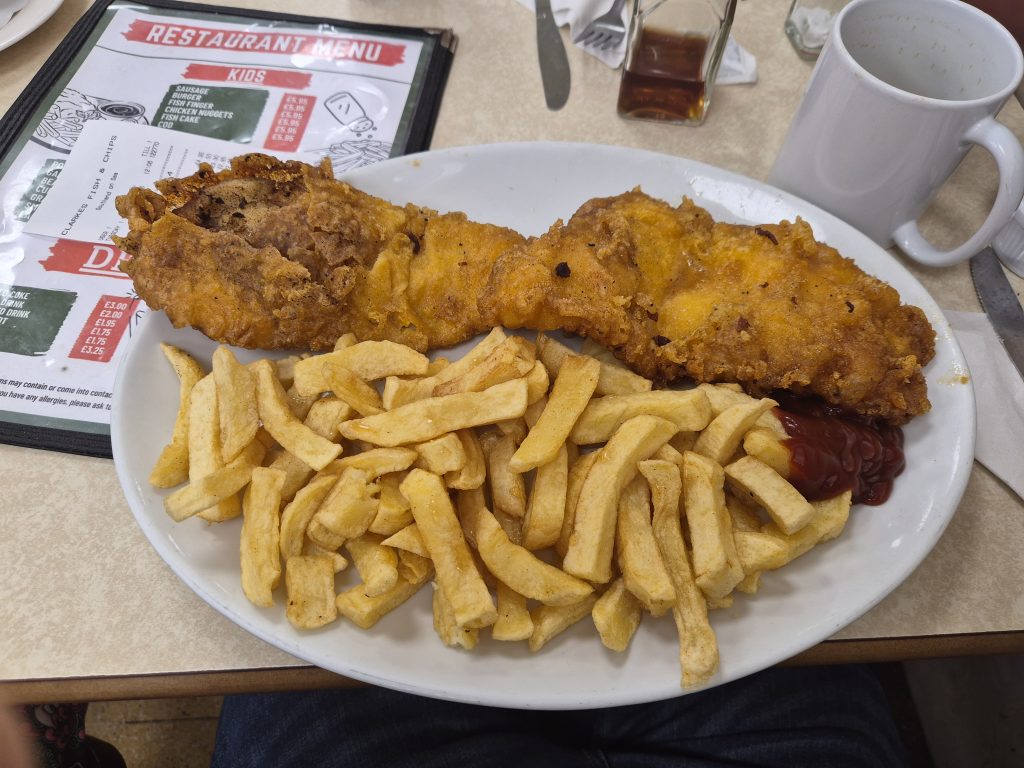
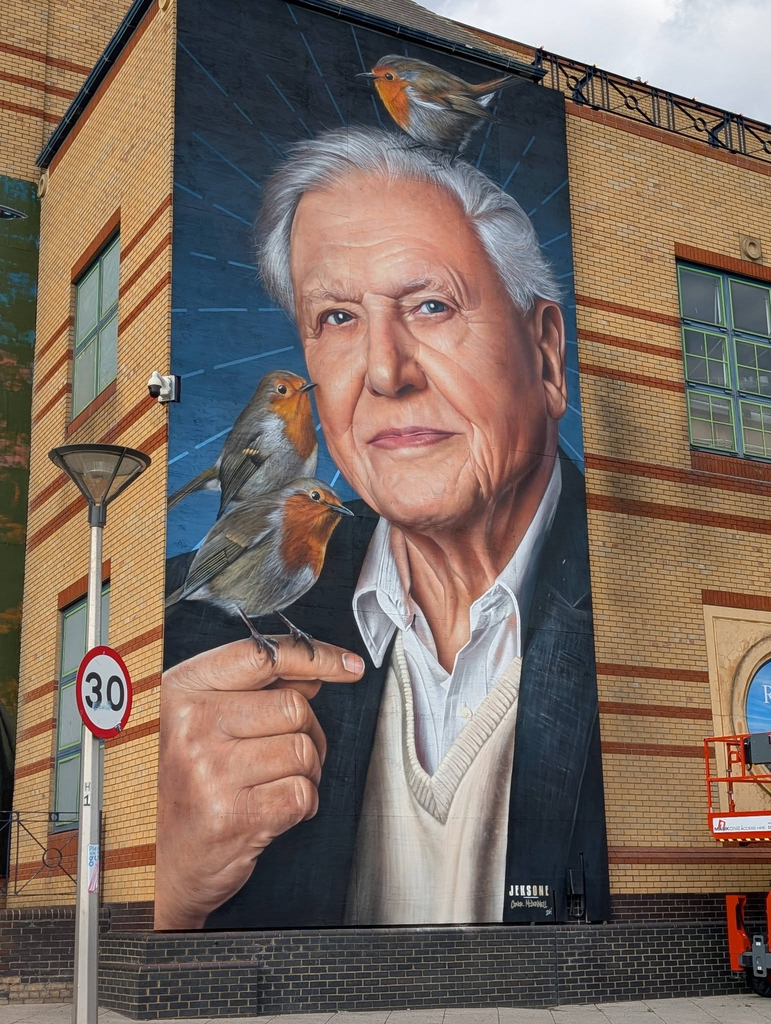
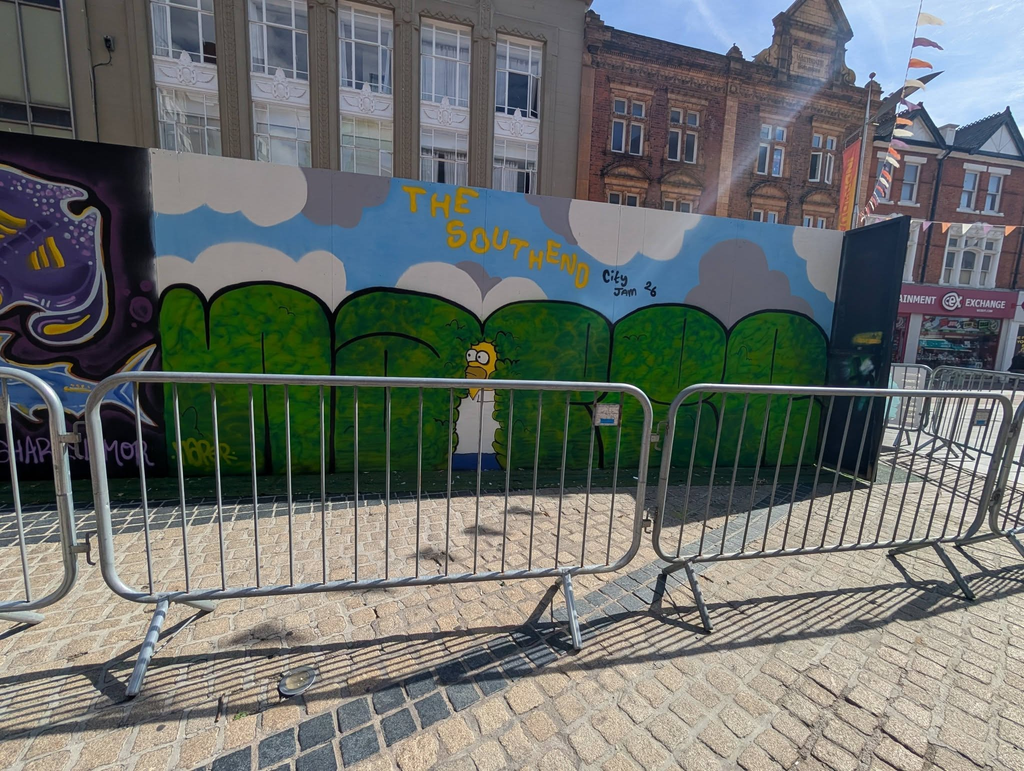
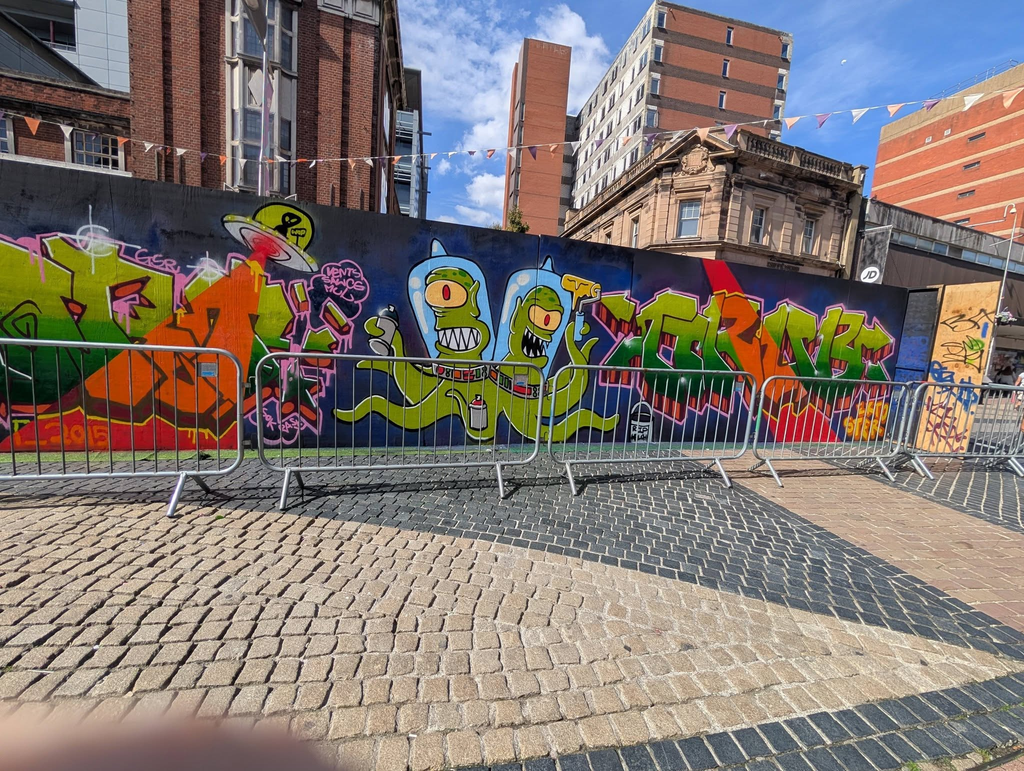
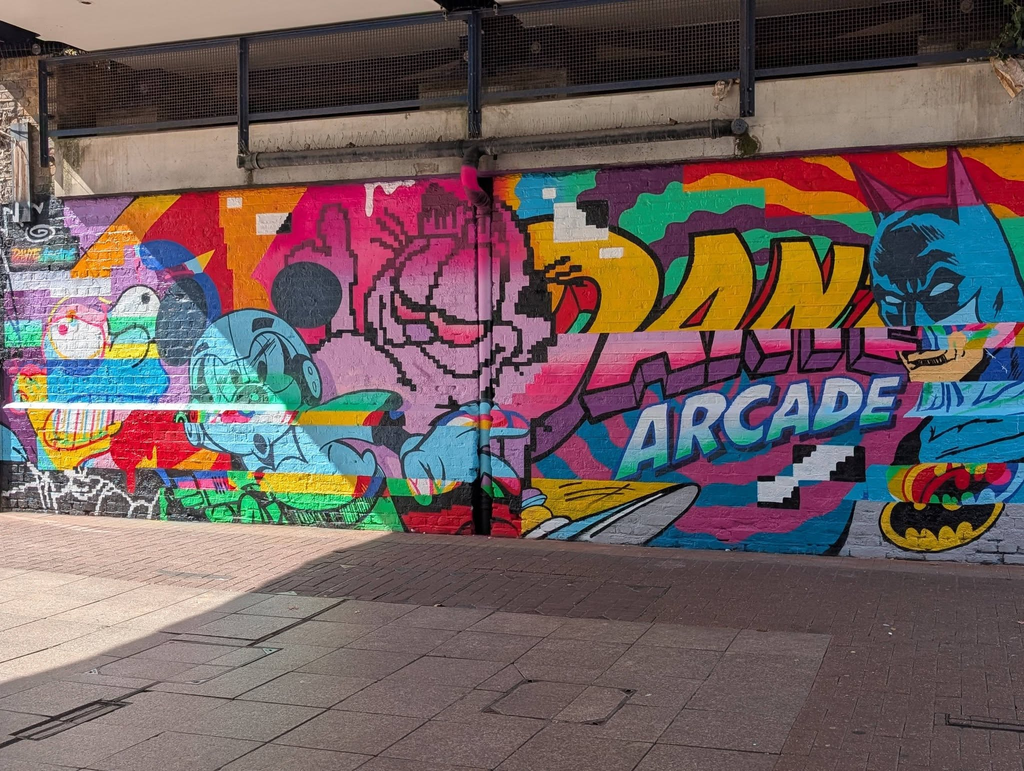
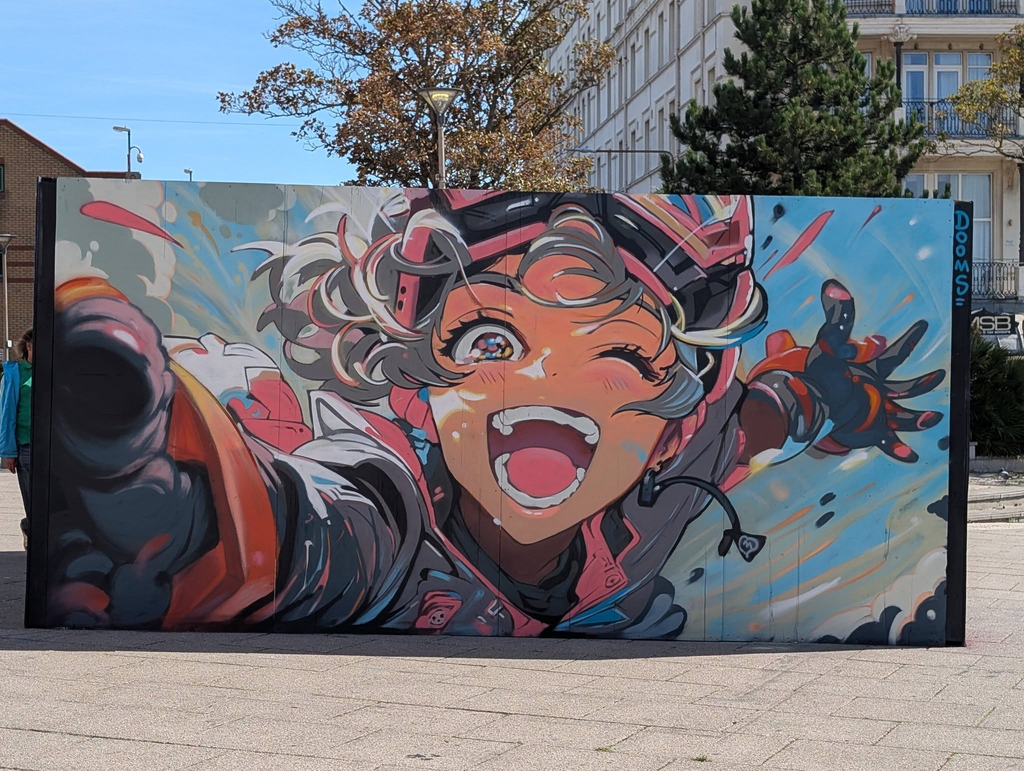
In the wake of a trip to my daughter’s college for a pre-start meeting, we carried on via bus to Southend. Once there, we visited the local Sea Life Centre, and befrore that had fish and chips, as tradition pretty much demands at a seaside town. There were a lot of murials that my wife took photos of, and a lot of walking! I don’t mind admitting that I felt shattered by the end, and whilst we took the bus home, I would have preferred the far quicker option of the train.

I must also admit to feeling stuffed! It was a very big portion of fish and chips…

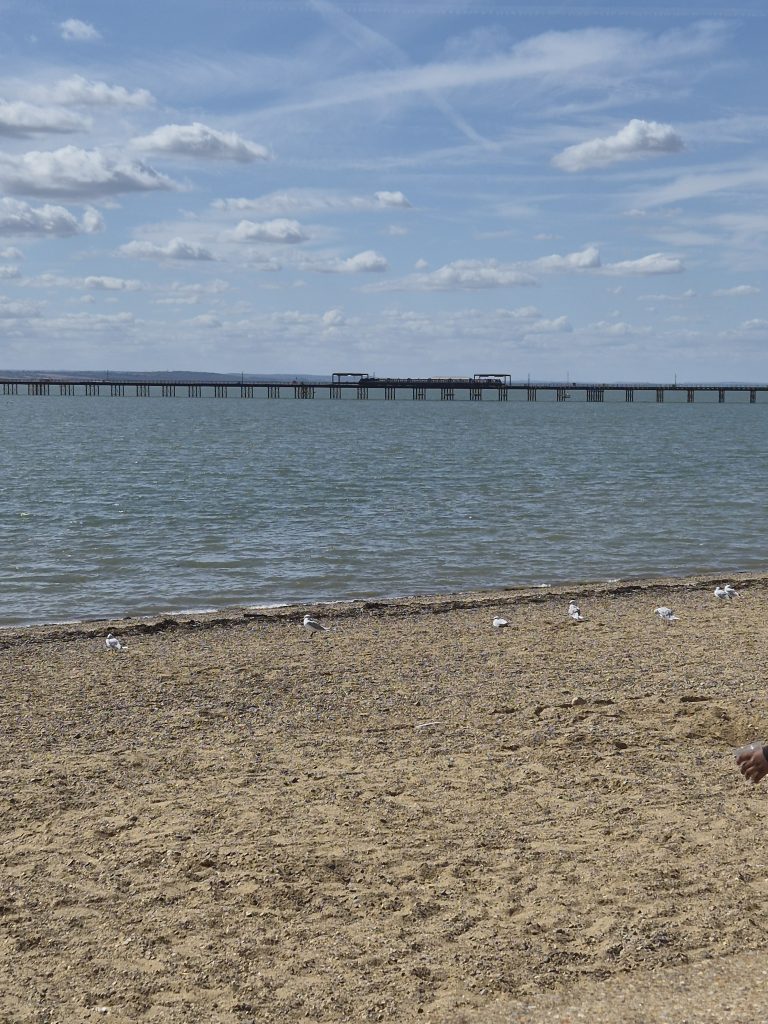
Next, a selection of my wife’s photos:

I couldn’t help but note how very different Southend’s beach is to the pristine white sands and crystal clear waters of Menorca or Sicily. It made me wistful for those locations!

The famous Southend Pier train can be seen trundling along.

The Bite

Something – possibly a spider though I don’t actually know – bit me at some stage, though it only became apparent when said bite – right on my shin – began to itch. Whatever it was, it may have done it twice, as another, smaller bite mark, on the same leg, also provided a measure of itchy fun.

17 Years

My wife and I have now been married for 17 years. It feels sort of surreal that our wedding day was all the way back in 2009, when so many things were different. We lived in a different house, I worked for a different place, a place now completely bulldozed, and our daughter was a twinkle in my eye.

What hasn’t changed is that I love my wife. She drives me mad, I drive her mad, and we face and fight the world together, as a team, with our daughter and for our daughter.

My wife is an anchor of stability in a universe of chaos. She is my best friend.

Backstage Chaos

I refer to Meerkat Musings itself! I don’t understand how, but following a raft of plugin updates, the administrative presentation is all screwy. Everything still works and it’s usable, it just looks scrambled. I don’t like it! I don’t immediately know how to undo it either, not without reversing important plugin updates. I think I’ll have to live with this for the time being. Oddly, whether the info displays correctly also appears to depend on what computer I’m using. I’ll never understand the technical side of this.

Ending as Beginning

Tuesday brought more rain, bookending this Muse rather nicely. It came down as my daughter started college, and as I endured a dreary, long day at work. I’ve felt a bit rundown these past couple of days, possibly the result of feeling anxious on behalf of my daughter, and just generally feeling tired. It feels like the past few weeks have been bitty, and busier than I have wanted. I cannot shake a general lethargy at the moment.

I did wonder if the spider bite might be the cause. I certainly hope not, but then it looked fairly meaty!

60 Years of Star Trek

It’s crazy to think that Star Trek, one of the most influential modern cultural movements of our time, began 60 years ago. The franchise’s reach has been nothing short of epic, with thousands of hours of inspirational material and broken boundaries.

Star Trek has left an indelible mark on me. The core messages of the franchise continue to be relevant, and are sorely needed in this broken world. I haven’t found the opportunity to develop an independent blog post on this subject, but I will certain revisit it in the near future.

Here’s to a mid-September Muse cycle that is a little more productive, though whether that proves the case remains to be seen. We shall find out!

Back to The Meerkat Muse

I did toy with labelling this post up as a Thinking ‘Kat post, since it touches upon a sinister element of society that is constantly bubbling away. There is however a part of me that also has to pause and laugh at the fragile egos of the manosphere. You see, there have been some ludicrous reactions to the latest GTA VI information and gameplay videos, and these reactions are worthy of lampooning.

A lot of this seems to be down to a fundamental misunderstanding of how relationships actually work. The basement dwellers, incels and the fragile egos of the manosphere are angry that the lead male character – Jason – is showing awareness, appreciation and understanding of his partner’s interests and situations. Newsflash to those who seem to think a relationship between a man and a woman should revolve around male egos: that’s not how real life works. Nor is how masculinity works.

Enthusiasm about your partner’s interests, a desire to please them, and a willingness to change are not emasculating properties. Realising there is more to a relationship than demands and expectations upon your partner will make that relationship stronger, and showing growth as a human being is not a sign you are not masculine.

I don’t know what exactly is the problem? GTA games are notorious and famous for controversy, and it looks like GTA VI will have that in spades. Why would anyone be so upset because *checks notes* the lead male character isn’t behaving like a cold douchebag? Why do people still think that’s what a good man should be?!

I really am baffled by this.

Back to Meerkat Prompts